
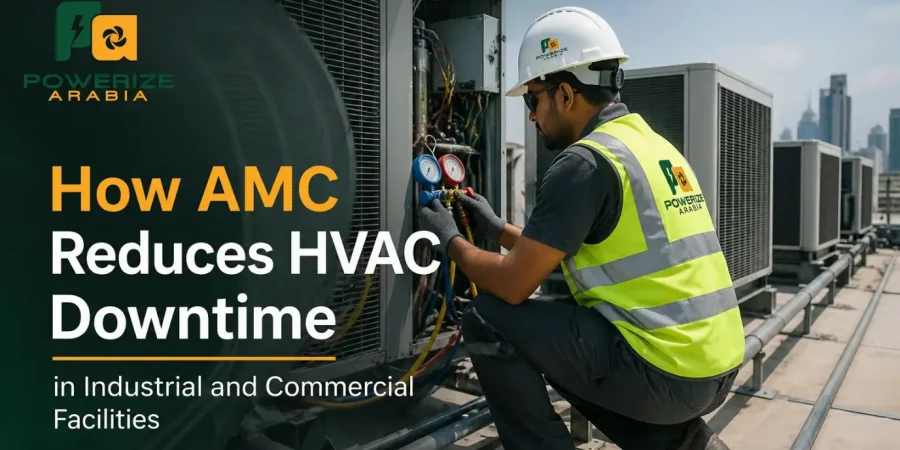
Unplanned HVAC failure in an industrial or commercial facility does not just cause discomfort. It halts production lines, disrupts operations, compromises indoor air quality, and in some facilities, creates serious safety and compliance risks.
The difference between a facility that experiences frequent, costly breakdowns and one that runs without interruption almost always comes down to one thing: whether maintenance is reactive or proactive.
An Annual Maintenance Contract (AMC) is the structured approach that shifts HVAC management from a “fix it when it breaks” model to a planned, preventive system that keeps critical equipment running reliably.
Keep reading as we break down exactly how an AMC reduces HVAC downtime, what mechanisms make it work, and what it means for your facility’s operations and budget.
What Is an HVAC Annual Maintenance Contract (AMC)?
An HVAC Annual Maintenance Contract is a formal service agreement between a facility owner or operator and a qualified HVAC service provider.
Under this contract, the provider takes responsibility for the scheduled inspection, maintenance, cleaning, calibration, and repair support of all HVAC systems within the facility over a defined period, typically 12 months.
The AMC replaces the traditional approach of calling for service only when equipment fails. Instead, it establishes a regular maintenance rhythm that identifies and resolves issues before they cause operational disruption.
For industrial and commercial facilities where HVAC systems run continuously, this structure is not a luxury. It is an operational necessity.
Why Do Industrial and Commercial Facilities Need an HVAC AMC?
HVAC systems in industrial and commercial environments face demands that far exceed what residential systems experience.
They run for longer hours, handle larger volumes of air, manage extreme temperature differentials, and are expected to perform with precision in environments where a failure can have immediate and significant consequences.
In a manufacturing facility, HVAC downtime can halt an entire production line. In a hospital, it can compromise infection control and patient safety. In a data centre, it can trigger equipment overheating within minutes. In a commercial office building, it directly impacts tenant satisfaction, lease renewals, and energy costs.
These are not scenarios where a “wait and see” approach to maintenance is acceptable.
A well-structured HVAC AMC addresses this by transforming maintenance from a response function into a prevention function.
How Does an AMC Reduce HVAC Downtime?
Research indicates that structured preventive maintenance programs can reduce total HVAC equipment breakdowns by 70 to 75% and decrease the duration of any necessary repairs by 35 to 45%.
These results come from several core mechanisms working together.
Early Fault Detection
Every major HVAC failure begins as a minor issue.
Loose electrical connections, refrigerant imbalances, worn belts, blocked drainage lines, and degraded insulation do not cause immediate breakdowns. They cause gradual stress on the system that compounds over time until a critical failure occurs.
Regular scheduled inspections under an AMC identify these issues at the earliest stage, when they are inexpensive and quick to fix, before they escalate into emergency shutdowns.
A trained technician visiting a system on a planned cycle can catch what an untrained facility manager would never notice, because they know what normal looks like and what does not.
Predictive Maintenance Integration
Advanced AMC programmes go beyond periodic inspection. They incorporate data collection and analysis to predict failures before they happen.
Vibration analysis detects bearing wear in motors and compressors. Temperature monitoring identifies heat buildup in electrical components. Current analysis flags motor inefficiency before it becomes motor failure.
This predictive layer allows repairs to be scheduled at the most convenient time for the facility, during planned downtime windows rather than during critical operating hours. Maintenance happens only when the data says it is needed, not on a fixed calendar regardless of actual system condition.
Priority Service Response
Even with strong preventive maintenance in place, some level of reactive response will always be required. The difference with an AMC is how quickly that response arrives.
AMC holders typically receive priority service with response times of 2 to 4 hours for critical systems. Non-contract clients often wait significantly longer, especially during periods of high demand or extreme weather.
When a critical system fails in a hospital, a food processing facility, or a data centre, the difference between a 4-hour response and a 24-hour response is not just inconvenience. It is measurable financial and operational loss.
Strategic Spare Parts Management
One of the most underappreciated causes of extended HVAC downtime is not the fault itself. It is the wait for parts.
When a compressor or control board fails on a commercial HVAC unit, sourcing the correct manufacturer-approved part through standard channels can take days or weeks. Every hour waiting for parts is an hour of downtime.
Quality HVAC AMC providers maintain a dedicated inventory of critical spare parts for the specific equipment they service under contract. When a part is needed, it is available. Repairs happen immediately, not after a supply chain delay.
System Calibration and Cleaning
Dirty coils and clogged filters are among the most common and preventable causes of HVAC compressor stress.
When evaporator and condenser coils are fouled with dust and debris, the system works harder to achieve the same output. This drives up energy consumption, increases thermal stress on compressor components, and shortens the time to failure.
An AMC includes scheduled coil cleaning, filter replacement, drainage maintenance, and system calibration as standard activities. These routine tasks prevent the compressor overload that leads to total system outages and eliminate the cascading stress pattern that causes multiple simultaneous failures.
What Are the Operational Benefits by Facility Type?
The impact of HVAC downtime varies by facility type. So does the value that a structured AMC delivers.
Industrial Facilities and Factories
In a manufacturing or industrial environment, HVAC systems support process cooling, ventilation for worker safety, and temperature control for product quality.
A single unplanned shutdown can halt an entire production line, trigger quality control failures, and result in losses that far exceed the annual cost of a maintenance contract. AMC-managed systems ensure production-critical HVAC runs without unplanned interruption.
Hospitals and Healthcare Facilities
HVAC reliability in a healthcare facility is a patient safety issue, not just a comfort issue.
Operating theatres, ICUs, sterile processing departments, and pharmaceutical storage areas all depend on precise temperature and air quality control. A failure in these environments can compromise infection control, violate compliance standards, and create direct clinical risk.
AMC-managed HVAC systems in healthcare settings provide the stability and rapid response capability that patient safety demands.
Data Centres
Cooling precision in a data centre is critical. Server equipment generates substantial heat, and even brief thermal excursions can cause hardware damage, data loss, and service outages.
Data centres require continuous monitoring and an extremely fast response window. An AMC that includes 24-hour monitoring integration and rapid response commitments is not optional for this facility type. It is a business continuity requirement.
Commercial Office Buildings
In a commercial office environment, HVAC failure directly affects tenant comfort, productivity, and satisfaction.
Persistent temperature complaints, poor air quality, and repeated outages drive tenant dissatisfaction, damage building reputation, and complicate lease renewals. An AMC keeps systems running consistently, supports strong energy performance, and demonstrates professional facility management to tenants and stakeholders.
What Are the Financial Benefits of an HVAC AMC?
The financial case for an HVAC AMC is straightforward when the true cost of reactive maintenance is understood.
Emergency Repairs Cost Significantly More
Emergency HVAC repairs cost 2 to 3 times more than the same repair carried out under a planned maintenance schedule.
Emergency call-out rates are higher. Parts sourced urgently command a premium. Labour for after-hours emergency work is billed at elevated rates. And the indirect cost of operational downtime during an emergency outage is often significantly larger than the repair bill itself.
An AMC converts unpredictable, high-cost emergency spending into a fixed, budgeted annual cost that is consistently lower.
Extended Equipment Lifespan
A commercial HVAC unit that receives regular, professional servicing has a significantly longer operational life than one managed reactively.
Industry data indicates that a poorly maintained commercial HVAC system typically lasts around 9 years before requiring replacement. With structured AMC-level servicing, the same system can operate reliably for 14 to 20 years.
For large industrial and commercial HVAC installations, where equipment replacement costs can run into hundreds of thousands, this lifespan extension represents a substantial return on the maintenance investment.
Energy Cost Reduction
Poorly maintained HVAC systems consume significantly more energy than well-maintained ones.
Dirty coils, low refrigerant charge, degraded motors, and blocked filters all force the system to work harder to deliver the same output. This energy penalty is invisible until the utility bill arrives.
Structured maintenance under an AMC typically improves HVAC energy efficiency by 15 to 30%. For large facilities with significant cooling loads, this saving alone can offset a substantial portion of the annual AMC cost.
What Should a Quality HVAC AMC Include?
Not all maintenance contracts are equal. A comprehensive HVAC AMC for industrial and commercial facilities should include the following as standard:
- Scheduled preventive maintenance visits at defined intervals (quarterly as a minimum for critical systems)
- Full inspection of all mechanical, electrical, and refrigerant components
- Coil cleaning and filter replacement
- System calibration and performance testing
- Refrigerant level check and top-up where required
- Drainage line inspection and clearance
- Electrical connection tightening and motor assessment
- Priority response commitment for emergency breakdowns, with clearly defined response time SLAs
- Access to a critical spare parts inventory for rapid repair resolution
- Documentation and service reports after every visit
- Optional: predictive monitoring integration with vibration, temperature, and current analysis
The quality of the service provider is as important as the scope of the contract. Choose a provider with demonstrated experience in your facility type, manufacturer-certified technicians, and a clear commitment to response time guarantees.
AMC vs Reactive Maintenance: A Direct Comparison
Understanding the difference between a managed AMC approach and reactive-only maintenance makes the value clear.
| Factor | With HVAC AMC | Reactive Maintenance Only |
| Breakdown Frequency | Reduced by 70 to 75% | Unpredictable, frequent |
| Repair Duration | Reduced by 35 to 45% | Longer, parts-dependent |
| Repair Cost | Fixed, lower annual spend | 2 to 3x higher per incident |
| Response Time | Priority, 2 to 4 hours | Standard queue, unpredictable |
| Equipment Lifespan | 14 to 20 years | Around 9 years |
| Energy Efficiency | 15 to 30% improvement | Degrades progressively |
| Budget Predictability | Fully predictable | Highly unpredictable |
| Compliance and Documentation | Maintained | Often absent |
For any facility where HVAC performance is operationally or financially significant, the case for an AMC is clear in every column.
How Do You Choose the Right HVAC AMC Provider?
Choosing the right AMC provider is as important as choosing to have one.
Questions to ask when evaluating an HVAC AMC provider include:
- Do they have direct experience with your facility type and the specific equipment installed?
- What are the guaranteed response time commitments for emergency breakdowns, in writing?
- Do they maintain a spare parts inventory for the brands and models they service?
- Are their technicians manufacturer-certified for your equipment?
- What documentation and reporting do they provide after each service visit?
- Do they offer monitoring integration or predictive maintenance capabilities?
- Is the contract scope clearly defined with no ambiguous exclusions?
A provider who can answer all of these questions clearly and confidently is one who understands what quality HVAC AMC delivery looks like in practice.
Frequently Asked Questions
1. What does an HVAC AMC cover?
A comprehensive HVAC AMC typically covers scheduled preventive maintenance visits, full system inspections, coil and filter servicing, refrigerant checks, electrical assessments, system calibration, drainage maintenance, and priority emergency response support. The exact scope varies by contract, so reviewing the inclusions carefully before signing is essential.
2. How much can an AMC reduce HVAC downtime?
Structured preventive maintenance programmes can reduce total equipment breakdowns by 70 to 75% and reduce the duration of repairs when they are needed by 35 to 45%, based on industry research across industrial and commercial HVAC applications.
3. Is an HVAC AMC worth the cost?
Yes, in almost all commercial and industrial contexts. Emergency repairs cost 2 to 3 times more than planned maintenance. Energy savings of 15 to 30% from a well-maintained system often offset a significant portion of the annual AMC cost. Equipment lifespan extension from 9 years to 14 to 20 years represents substantial deferred capital expenditure. The total financial return consistently exceeds the AMC investment.
4. How often should HVAC systems be serviced under an AMC?
For critical industrial and commercial systems, quarterly preventive maintenance visits are a standard minimum. High-demand environments such as data centres, hospitals, and continuous production facilities may benefit from monthly or even continuous monitoring arrangements.
5. What is the difference between preventive and predictive maintenance in an HVAC AMC?
Preventive maintenance involves scheduled, routine servicing at fixed intervals regardless of system condition. Predictive maintenance uses data collection tools, such as vibration analysis, temperature monitoring, and current analysis, to identify early indicators of failure and schedule repairs only when the data shows they are needed. Many advanced AMC programmes combine both approaches.
6. Can an AMC extend the life of my HVAC equipment?
Yes. A poorly maintained commercial HVAC system typically lasts around 9 years before requiring replacement. With consistent, professional servicing under an AMC, the same equipment can operate reliably for 14 to 20 years. This lifespan extension is one of the strongest financial arguments for investing in a structured maintenance contract.
7. What happens if HVAC breaks down outside of business hours?
A quality AMC should include a clearly defined after-hours emergency response commitment. Reputable providers offer priority response for AMC clients that covers critical breakdowns outside standard business hours, with defined response time SLAs agreed in the contract.
Conclusion
HVAC downtime in industrial and commercial facilities is not an unpredictable risk. It is largely a preventable one.
The data is consistent. Facilities that invest in structured HVAC maintenance contracts experience far fewer breakdowns, respond faster when issues do occur, spend less on repairs over time, and get significantly more operational life from their equipment.
The choice between an AMC and reactive-only maintenance is not just a facilities management decision. It is a business continuity decision.
If your facility depends on reliable HVAC performance, whether in a factory, a hospital, a data centre, or a commercial building, a well-structured Annual Maintenance Contract with the right provider is the most practical step you can take to protect that reliability.
Powerize Arabia provides HVAC AMC services for industrial and commercial facilities, offering structured maintenance programmes built around your specific systems, priority response commitments, and the technical depth that critical facility environments demand. Getting your HVAC maintenance programme in place before the next breakdown is always better than responding to one.