

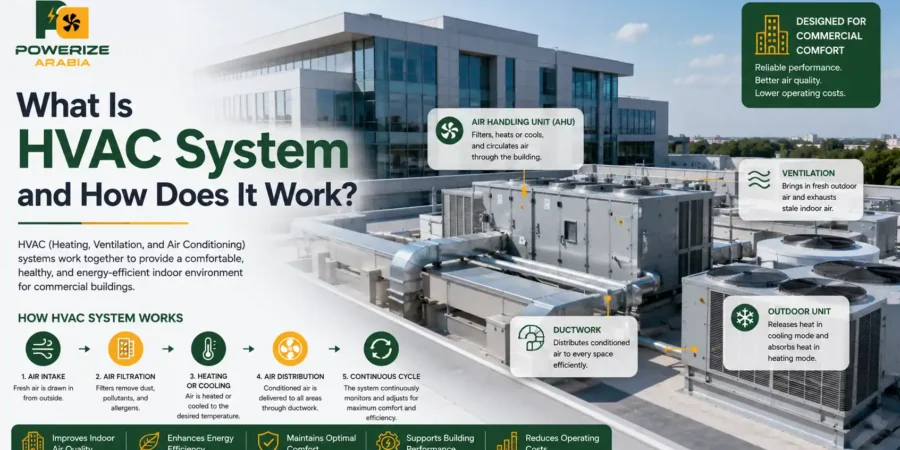
HVAC stands for Heating, Ventilation, and Air Conditioning. It is the system responsible for controlling temperature, air quality, and humidity inside any building, from a family home to a hospital, a school, a factory, or a high-rise office tower.
Most people interact with HVAC every day without thinking about it. When a room feels comfortable regardless of the weather outside, that is the system working correctly. When it isn’t working correctly, the signs show up as uneven temperatures, stuffy air, high energy bills, or equipment that runs constantly without achieving the right conditions.
Understanding how the system works helps homeowners, building managers, and facility teams make better decisions about installation, maintenance, and energy use.
What HVAC Stands For and What Each Letter Means
| Letter | Stands For | What It Does |
|---|---|---|
| H | Heating | Warms indoor air using furnaces, boilers, heat pumps, or electric heating elements |
| V | Ventilation | Brings in fresh outdoor air, removes stale indoor air, and filters airborne pollutants |
| AC | Air Conditioning | Removes heat and moisture from indoor air to cool and dehumidify the space |
All three functions work together. A system focused only on heating and cooling, while neglecting ventilation, will produce uncomfortable temperatures but poor air quality. According to the U.S. Environmental Protection Agency, the primary purpose of an HVAC system is to maintain good indoor air quality through adequate ventilation with filtration, alongside providing thermal comfort.
The Main Components of an HVAC System
Different buildings use different combinations of equipment, but most HVAC systems share the same core parts.
Heating Source Provides warmth when outdoor temperatures drop. In residential buildings, this is typically a furnace (gas or electric) or a heat pump. In larger buildings, boilers produce hot water that circulates through the system to radiators or air handling units.
Cooling Source Removes heat from indoor air. Residential systems use split-system air conditioners with an outdoor condensing unit and an indoor evaporator coil. Larger commercial buildings use chillers that produce chilled water distributed throughout the building.
Air Handling Unit (AHU) A large cabinet containing fans, filters, and heating or cooling coils. The AHU draws in air, conditions it, and pushes it through the ductwork. In smaller systems, this function is handled by the indoor unit of a split system or a packaged rooftop unit.
Ductwork The network of channels that carries conditioned air from the air handler to every room through supply registers, and returns used air back through return grilles. Duct condition directly affects how efficiently the system performs.
Thermostat and Controls The interface that tells the system when to run and at what level. Modern smart thermostats learn occupancy patterns and adjust output automatically. In large buildings, a Building Management System (BMS) handles this across hundreds of zones simultaneously.
Filters Capture dust, pollen, allergens, and other airborne particles before the air reaches the living or working space. Filter grade (measured by MERV rating) determines which particle sizes get captured. Filters need regular replacement to maintain both air quality and system efficiency.
Refrigerant The working fluid inside cooling systems that absorbs heat indoors and releases it outside through a cycle of compression and expansion. It is what makes air conditioning physically possible.
How an HVAC System Works: Step by Step
The process is the same whether the system serves a single room or an entire skyscraper.
- Air is returned: Used air from inside the building is pulled back through return grilles into the system.
- Outdoor air is added: Fresh air from outside is drawn in and mixed with the return air to maintain adequate ventilation.
- Air is filtered: The mixed air stream passes through filters that remove dust, allergens, and particulates.
- Air is conditioned: The filtered air passes over heating or cooling coils and reaches the required supply temperature.
- Air is distributed: A blower fan pushes the conditioned air through supply ductwork to every room or zone.
- The cycle repeats: The process continues as long as the system is running, constantly exchanging and conditioning the air.
Types of HVAC Systems
The right system depends on building size, layout, climate, and budget. Here are the most common configurations:
| System Type | How It Works | Best Suited For |
|---|---|---|
| Split system | Separate outdoor and indoor units connected by refrigerant lines | Homes, small offices, apartments |
| Packaged unit | All components in one cabinet, usually rooftop-mounted | Small commercial buildings, warehouses |
| Central chiller with AHU | Chilled water produced centrally, distributed via air handling units | Large offices, hospitals, malls |
| VRF/VRV system | Refrigerant flows directly to multiple indoor units; variable-speed compressor | Hotels, mixed-use buildings, retrofits |
| Heat pump | Single system for both heating and cooling; reverses the refrigeration cycle | Homes and light commercial in moderate climates |
| Ductless mini-split | No ductwork required; indoor units mount on walls or ceilings | Additions, older buildings, server rooms |
Each system type has a different cost profile, installation requirement, and efficiency characteristic. There is no universally best option; the right choice depends on the specific building and how it is used.
HVAC and Energy Use
HVAC is the single largest energy consumer in most buildings. In commercial settings, it accounts for 40 to 50% of total energy use according to the U.S. Energy Information Administration. In homes, heating and cooling typically represent 40 to 50% of the electricity bill as well.
Several factors affect how much energy a system uses:
- Whether the system is correctly sized for the space
- How well the building envelope (insulation, windows, seals) retains conditioned air
- The condition and sealing of the ductwork
- How regularly the system is maintained
- Whether controls adjust output based on actual occupancy
ASHRAE Standard 90.1-2022 sets the current energy efficiency benchmark for commercial HVAC. For residential systems, SEER2 (Seasonal Energy Efficiency Ratio) ratings indicate cooling efficiency, where higher numbers mean lower operating costs.
HVAC and Indoor Air Quality
The quality of the air inside a building is directly shaped by how well the HVAC system is designed and maintained. Most people spend 90% of their time indoors, and according to the EPA, indoor air can be two to five times more polluted than outdoor air when systems are not working properly.
Key air quality factors the HVAC system controls:
- CO₂ levels: Fresh air exchange rate determines how quickly CO₂ from occupants is diluted. High CO₂ causes fatigue and reduced concentration.
- Particulate matter: Filter grade determines what gets captured. Inadequate filtration allows dust, allergens, and fine particles to circulate continuously.
- Humidity: Ideally kept between 40 and 60% relative humidity. Too high encourages mould growth; too low causes respiratory irritation and static buildup.
- VOCs and odours: Adequate air changes dilute volatile organic compounds from furniture, cleaning products, and building materials.
- Biological contaminants: Regular duct cleaning, coil maintenance, and drain pan management prevent mould and bacteria from entering the air supply.
Powerize Arabia Limited Company provides HVAC installation, maintenance, and IAQ services including duct cleaning and Building Management System integration, covering both the mechanical system and air quality outcomes together.
Why HVAC Maintenance Matters
A system that was installed correctly and runs without failures still needs scheduled maintenance. Performance degrades gradually and invisibly without it.
What happens when maintenance is skipped:
- Fouled coils reduce heat transfer and increase energy consumption
- Clogged filters raise static pressure, overworking fan motors
- Refrigerant leaks reduce cooling capacity without obvious symptoms
- Drain pans accumulate biological growth that enters the air supply
- Duct leaks grow at joints and waste conditioned air before it reaches the room
According to ASHRAE, a well-maintained HVAC system operates close to its rated efficiency throughout its lifespan. A neglected one can lose 15 to 25% of its efficiency within just a few years of installation.
Basic maintenance tasks every building or homeowner should keep up with:
- Replace filters every 1 to 3 months depending on usage and environment
- Schedule professional servicing at least once a year (twice for heavy-use systems)
- Keep outdoor units clear of debris and obstructions
- Check that all vents and return grilles are unobstructed
- Monitor energy bills for unexplained increases, which often signal system problems
How Long Does an HVAC System Last?
| Component | Typical Lifespan (with maintenance) | Common Cause of Early Failure |
|---|---|---|
| Central air conditioner | 15-20 years | Refrigerant leaks, dirty coils |
| Furnace | 15-20 years | Heat exchanger cracks, burner issues |
| Heat pump | 15-20 years | Reversing valve failure, refrigerant loss |
| Ductwork | 25-30 years | Leaks at joints, insulation degradation |
| Thermostat/controls | 10-15 years | Sensor drift, software obsolescence |
| Chiller (commercial) | 20-25 years | Compressor failure, refrigerant loss |
Lifespan depends heavily on how the system is used and whether it receives regular servicing. Systems in extreme climates that run year-round reach end of life faster than those with seasonal rest periods.
Frequently Asked Questions
1. What is the difference between HVAC and AC?
AC (air conditioning) refers only to cooling. HVAC is the full system: heating, ventilation, and air conditioning together. When someone says their “AC is broken,” they usually mean the cooling function specifically. The HVAC system as a whole includes heating and fresh air management as well.
2. Do all homes have HVAC systems?
Most modern homes have some form of HVAC, though not always as a single integrated system. A home might have a furnace for heating, a separate window unit for cooling, and no mechanical ventilation at all. A full HVAC system combines all three functions in one coordinated setup.
3. What size HVAC system do I need?
Size is determined by a load calculation that accounts for the floor area, ceiling height, insulation quality, window area, local climate, and occupancy. A system that is too large short-cycles and does not dehumidify properly. One that is too small runs continuously without reaching the setpoint. Neither is efficient or comfortable.
4. How do I know if my HVAC system needs replacing?
Key indicators include: the system is over 15 years old, repair costs exceed 50% of replacement cost, energy bills have increased steadily without explanation, or comfort complaints persist despite servicing. An assessment by a qualified technician gives a clearer picture than age alone.
5. What is the difference between a heat pump and an air conditioner?
A standard air conditioner only cools. A heat pump can both cool and heat by reversing the refrigeration cycle; it moves heat out of the building in summer and pulls heat from outside air into the building in winter. Heat pumps are more energy-efficient for heating than electric resistance heating in moderate climates.
6. How often should HVAC filters be changed?
Every 1 to 3 months for most residential systems. Homes with pets, allergy sufferers, or dusty environments need more frequent changes. Commercial buildings in high-dust environments may need monthly replacements. A clogged filter is one of the most common and easily preventable causes of system inefficiency.
Additional Resources
For further reading from authoritative sources:
- EPA: HVAC Systems and Indoor Air Quality: ventilation design requirements and IAQ guidance
- ASHRAE Standard 62.1: ventilation for acceptable indoor air quality
- ASHRAE Standard 90.1: energy efficiency standards for buildings
- U.S. Energy Information Administration: data on energy consumption in buildings
Conclusion
An HVAC system is not one device. It is a collection of components working together to control temperature, air quality, and humidity in any space where people live or work. Every home, office, school, hospital, and factory depends on one in some form.
The difference between a system that works well and one that doesn’t usually comes down to three things: whether it was correctly sized for the building, whether it was properly installed and commissioned, and whether it receives scheduled maintenance rather than just emergency repairs.
Understanding the basics, what the components are, how the air cycle works, what affects efficiency, and what maintenance is actually required, puts anyone in a better position to manage their system, ask the right questions of technicians, and avoid paying for problems that were preventable.
Whether you are a homeowner trying to understand a service quote, a facilities manager overseeing a large building, or someone planning a new installation, the fundamentals of how HVAC works remain the same. The scale changes; the principles do not.