
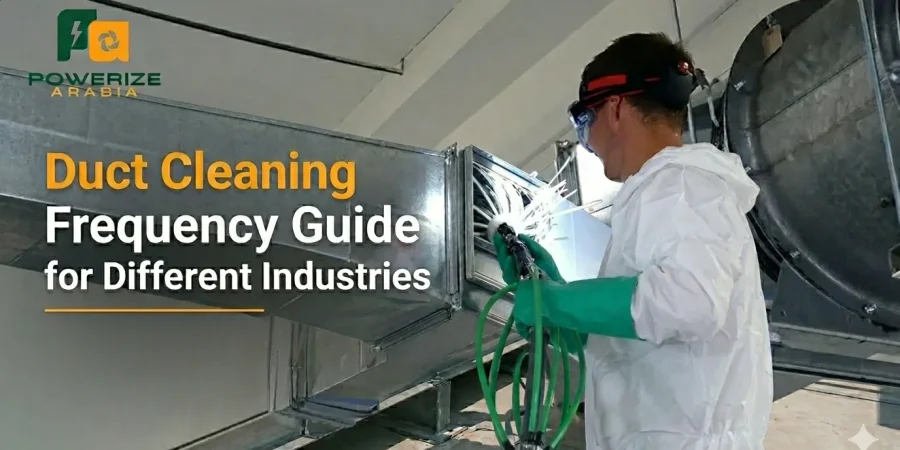
Duct cleaning frequency depends on your industry, not a generic calendar.
A hospital operating theatre, a commercial kitchen, and a corporate office each push different contaminants through their ductwork at completely different rates.
Treating them all with the same 3-to-5-year schedule risks compliance failures, rising energy bills, and poor indoor air quality for every person inside the building.
This guide breaks down exactly how often each industry should be cleaning its ducts, which regulations govern those intervals, and the warning signs that mean you cannot wait.
The Baseline: What NADCA Recommends
The National Air Duct Cleaners Association (NADCA) sets the professional benchmark for commercial duct cleaning.
General Recommendation
- Every 3–5 years for standard commercial properties
- Annual visual inspections of air handling units (AHUs) regardless of cleaning cycle
- Filter replacement every 1–3 months to extend the interval between deep cleans
Important Caveat
NADCA’s 3–5 year figure is a floor, not a ceiling.
High-occupancy, high-contamination, or regulated environments need far more frequent attention — as the industry breakdown below shows.
Not sure what to look for in a contractor? Read: Benefits of Choosing a Certified HVAC Air Duct Cleaning Company
Duct Cleaning Frequency by Industry — Quick Reference
| Industry / Facility | Cleaning Frequency | Governing Standard |
| Healthcare (Hospitals, Clinics) | Every 1–2 years | ASHRAE 170 / Joint Commission |
| Commercial Kitchens & Food Service | Every 3–12 months | NFPA 96 |
| Industrial & Manufacturing | Every 1–3 years | OSHA PELs / NFPA 652 |
| Schools & Universities | Every 1–3 years | NADCA / Local Health Authority |
| Offices & Retail | Every 3–5 years | NADCA Baseline |
| Hotels & Hospitality | Every 2–3 years | IAQ / Occupancy Standards |
| Light Commercial (High-pollution areas) | Every 2–3 years | Environmental Load |
1. Healthcare Facilities — Every 1 to 2 Years
Healthcare is the most tightly regulated environment for indoor air quality. Ductwork is not just an efficiency concern here — it is a direct patient safety issue.
Key Standards
- ASHRAE Standard 170 — Ventilation of Health Care Facilities
- Joint Commission — requires regular AHU inspection and cleaning
- CBAHI — GCC equivalent for healthcare accreditation (Saudi Arabia)
Cleaning Requirements
- Supply air diffusers in ORs and ICUs: clean at least annually, semi-annually in high-traffic units
- Post-construction cleaning is mandatory before any area reopens to patients
- AHU components — coils, drain pans, humidifiers — must be inspected at each annual cycle
Why It Matters
The CDC reports that 1 in 31 hospital patients in the US is affected by a hospital-acquired infection (HAI) on any given day. Contaminated ductwork is a direct transmission route for airborne pathogens.
2. Commercial Kitchens & Food Service — Every 3 to 12 Months
No other industry has its duct cleaning schedule written directly into law quite like food service. NFPA 96 mandates specific intervals based on daily cooking volume and fuel type.
NFPA 96 Schedule
| Cooking Volume / Fuel Type | NFPA 96 Frequency |
| Solid fuels (wood, charcoal, briquettes) | Monthly |
| High-volume (24-hr restaurants, charbroiling, wok) | Every 3 months |
| Moderate-volume (standard sit-down restaurants) | Every 6 months |
| Low-volume (churches, seasonal, day camps) | Annually |
Why It Matters
- Grease accumulation in exhaust ductwork is the leading cause of commercial kitchen fires
- Non-compliance with NFPA 96 is a direct fire code violation and can result in facility closure
- In the GCC, Civil Defence regulations align closely with NFPA 96 for all food service operations
See our dedicated service: Kitchen Exhaust Cleaning — compliant with NFPA 96 and TR19® standards.
3. Industrial & Manufacturing — Every 1 to 3 Years
Manufacturing plants, chemical facilities, and workshops generate industrial-scale contaminants that circulate through HVAC ductwork.
Governing Standards
- OSHA PELs — Permissible Exposure Limits for airborne substances
- NFPA 652 — Fundamentals of Combustible Dust — requires controlling accumulations before hazardous levels are reached
Typical Cleaning Intervals
- High-dust production (wood, grain, chemical): quarterly to semi-annually
- Standard manufacturing environments: every 1–2 years
- Low-contamination light industry: every 2–3 years
Important Note
Industrial ductwork often qualifies as a permit-required confined space under OSHA 1910.146. Always verify that any contractor engaged is certified and insured for confined-space work.
4. Schools & Universities — Every 1 to 3 Years
Educational facilities carry high daily occupancy with constant movement between indoor and outdoor environments — a combination that raises particulate load quickly.
Recommended Practice
- Full clean every 1–3 years depending on occupancy density and activity level
- Inspections typically scheduled at the start or end of academic terms when buildings are vacant
- Post-renovation cleaning is critical — do not reopen HVAC before a full inspection and clean
Why It Matters
Studies show a direct link between indoor air quality in schools and student attendance, concentration, and staff productivity. Poor IAQ is measurable in academic performance data.
5. Offices & Retail — Every 3 to 5 Years
Standard commercial offices and retail spaces carry the lightest contamination loads. NADCA’s 3-to-5-year baseline is a reasonable starting point for most — but it is still just a starting point.
When to Move to a Shorter Cycle
- Ground-floor retail near busy roads or construction zones
- High-rise buildings in city centres with heavy outdoor pollution
- Post-renovation or post-fitout environments
- Significant increase in headcount or operational hours
Best Practice
Annual visual inspection of AHUs remains recommended even in clean-profile commercial buildings.
6. Hotels & Hospitality — Every 2 to 3 Years
Hotels combine high occupant turnover, on-site restaurant kitchens, laundry operations, and extensive multi-floor duct networks — an occupancy profile that demands more frequent attention than a standard office.
Recommended Schedule
- Deep duct clean every 2–3 years
- Monthly filter changes as standard
- Annual AHU inspection
- High-occupancy urban properties: target the 2-year end of the range
Why It Matters
Guest complaints about dust, odours, or air quality translate directly to negative reviews and lost bookings. IAQ is a guest experience issue, not just a maintenance one.
Factors That Push Your Schedule Earlier
Your industry sets the baseline. These factors override it regardless of the last clean date.
- Recent Renovation or Construction: Drywall dust and insulation fibres fill ductwork within weeks. Post-construction inspection is always required.
- High Outdoor Pollution Load: Facilities near motorways, industrial estates, or coastal high-humidity areas accumulate debris faster.
- Increased Occupancy or Shift Changes: More people mean more particulates. The original schedule no longer reflects actual contamination load.
- HVAC System Changes: New AHUs or duct extensions disturb existing debris and introduce installation particulates.
- Post-Flooding or Water Ingress: Any moisture event creates immediate mould risk. Inspect within days, not months.
The Role of Filter Maintenance
Duct cleaning and filter maintenance work together — one does not replace the other.
How Filters Extend Your Cleaning Interval
- High-efficiency filters catch particulates before they enter the duct system
- Reduces the rate of debris accumulation between professional deep cleans
- NADCA and the EPA recommend filter replacement every 1–3 months in commercial settings
Unsure whether MERV 13 or HEPA is right for your system? Read: Differences Between a MERV 13 and a HEPA Filter
Energy & Cost Impact
The Numbers
- 40% of commercial building energy consumption is attributed to HVAC systems (U.S. Department of Energy)
- 20–30% efficiency loss linked to dirty coils and restricted airflow (ACCA research)
- USD 450–USD 1,000+ typical cost range for small office duct cleaning; industrial facilities can run into tens of thousands
The ROI Case
When weighed against energy savings, reduced HVAC repair bills, and regulatory fines — particularly in food service and healthcare — regular duct cleaning has a clear return on investment.
Pair duct cleaning with a structured maintenance programme: How AMC Reduces HVAC Downtime in Industrial and Commercial Facilities
Red Flags: When Duct Cleaning Cannot Wait
Do not wait for your scheduled interval if any of the following are present.
| Red Flag | What It Signals | Who It Affects |
| Dust puffs from vents | Return plenum is full; filters may be failing | Offices, retail, schools |
| Musty or mouldy odour | Moisture build-up or mould growth inside ducts | Hospitals, hotels |
| Grease leaking at duct joints | Direct fire code violation — clean immediately | Commercial kitchens |
| Visible pest debris | Contamination risk; sanitisation required | Food manufacturing |
| Spike in occupant complaints | High particulate load circulating through HVAC | All facility types |
| Post-construction dust | Renovation debris fills ductwork within weeks | Any post-renovation facility |
Frequently Asked Questions
1. How do I know if my ducts actually need cleaning, or if a contractor is upselling me?
Ask for a pre-cleaning camera inspection. A NADCA-certified contractor will show photo or video evidence of contamination before starting any work. If a company quotes without inspecting first, that is a red flag.
2. Does duct cleaning spread mould through the building?
Only if done incorrectly. Professional source-removal cleaning places the system under negative pressure before any agitation begins, so contamination cannot escape into the occupied space. Always verify that your contractor uses source-removal methods.
3. Can duct cleaning improve HVAC energy efficiency?
Yes — particularly when the clean covers AHU coils, blower components, and drain pans alongside the ductwork itself. A full system clean delivers the most measurable energy benefit.
4. My building was just renovated. Do I need a duct clean even if one was done 12 months ago?
Yes. Construction debris travels deep into ductwork very quickly. Even a week of renovation activity can undo a recent clean. A post-construction inspection and clean is always required before returning to normal HVAC operation.
5. Is duct cleaning regulated in Saudi Arabia and the GCC?
Yes. Civil Defence regulations in KSA mandate kitchen exhaust cleaning aligned with NFPA 96. Healthcare facilities must comply with CBAHI standards, which incorporate ASHRAE 170 principles. Municipal health authority inspections for commercial facilities are increasing under Vision 2030 built-environment quality initiatives.
6. How long does commercial duct cleaning take?
A small office (500–1,000 sq m) typically takes half a day. A large hospital wing or industrial facility can require multiple days across several service visits. Your contractor should provide a full scope of work and timeline before starting.
Conclusion
There is no universal answer to how often ducts should be cleaned — only the right answer for your specific industry, occupancy, and regulatory environment.
Healthcare and food service facilities face mandatory compliance-driven schedules. Industrial plants must keep pace with production-level contamination. Schools and offices can operate on longer cycles, provided filter changes and annual inspections are consistent.
A proactive, schedule-driven approach consistently outperforms a reactive one — in cost, compliance, and occupant health outcomes.
Powerizearabia is a leading HVAC and IAQ services provider serving commercial, industrial, and institutional clients across Eastern Province, Saudi Arabia. Our duct cleaning and IAQ services are carried out by NADCA-certified technicians with full pre- and post-inspection camera documentation. Contact our team for an assessment.