
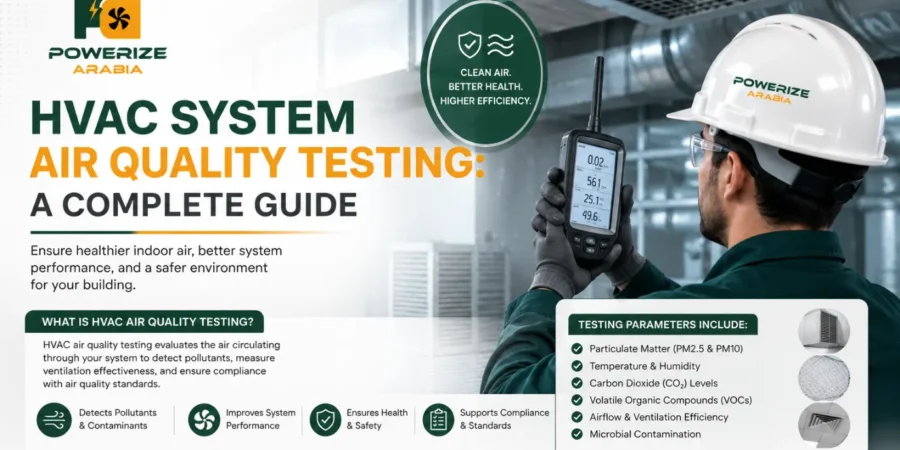
In a commercial office, a hospital, a shopping mall, or an industrial plant, the air moving through the ventilation system is doing more than keeping people comfortable. It carries the dust, fumes, and microbial load of the entire building, and it directly affects worker health, equipment reliability, and regulatory standing. Because the heating, ventilation, and air conditioning system controls how that air is filtered and circulated, HVAC air quality testing is one of the most effective ways for any facility to understand what its occupants and processes are actually exposed to.
For larger operators, poor indoor air quality is not just a comfort issue, it is a compliance, productivity, and downtime risk. This guide explains what HVAC system air quality testing measures, the tools and standards involved, and how to turn results into a safer, more efficient building.
What Is HVAC Air Quality Testing?
Indoor air quality (IAQ) describes the condition of air inside a building and how it affects the people and processes within it. Ventilation design, air exchange rate, filtration, occupant density, and the building’s own activities, from cooking to manufacturing, all shape that air.
HVAC air quality testing is a structured assessment of indoor air as it relates specifically to a building’s heating, ventilation, and air conditioning systems. Rather than a single comfort reading, it evaluates how air, contaminants, and pressure move across multiple zones, floors, and process areas.
Global authorities such as the U.S. Environmental Protection Agency (EPA) and the World Health Organization treat indoor environmental quality as a core pillar of healthy, productive buildings, and professional testing is how facilities put that standard into practice.
A facility-grade assessment typically covers:
- Airborne pollutants and chemical indicator compounds
- Ventilation effectiveness and air exchange rate across zones
- HVAC performance, airflow distribution, and pressure balance
- Process-related and occupancy-related contamination sources
Why It Matters for Your Building
In a busy facility, the HVAC system does not create pollutants, but it distributes them efficiently. A contaminant generated in one process area or one floor can be pushed through shared ductwork into offices, retail space, or patient areas far from the source. The stakes scale with the size of the building and the number of people inside it.
| Business Risk | How Poor IAQ Causes It | Operational Impact |
|---|---|---|
| Health and safety | Dust, VOCs, CO, mold circulating through ducts | Absenteeism, complaints, liability |
| Reduced productivity | High CO2 and stale air dulling concentration | Lower output, more errors |
| Regulatory exposure | Levels exceeding ASHRAE / OSHA / EPA guidance | Citations, failed audits |
| Energy and cost waste | Clogged filters, duct leaks, imbalanced airflow | Higher bills, premature wear |
| Equipment and downtime | Contaminants in machine rooms and data centers | Failures, unplanned shutdowns |
Testing converts these abstract risks into measurable data a facility manager can act on, before they turn into a citation, a shutdown, or a wave of occupant complaints.
Common Pollutants Found in HVAC Systems
A professional test should surface both routine and process-specific contaminants. The table below maps the most common ones to their typical sources.
| Pollutant | Common Sources | Possible Effects |
|---|---|---|
| Particulate matter (PM2.5 / PM10) | Production dust, traffic, dirty filters | Respiratory irritation, aggravated asthma |
| Mold spores | Cooling towers, leaks, humidity, drain pans | Allergies, congestion, persistent illness |
| Volatile organic compounds (VOCs) | Solvents, coatings, adhesives, cleaning agents | Headaches, dizziness, long-term risk |
| Carbon dioxide (CO2) | High occupancy, weak fresh-air intake | Drowsiness, poor concentration |
| Carbon monoxide (CO) | Boilers, furnaces, forklifts, loading docks | Headache, nausea, poisoning at high levels |
| Process gases / fumes | Manufacturing, labs, kitchens | Varies by industry and exposure level |
In industrial settings in particular, VOCs and process fumes off-gassing from solvents and raw materials are a frequent concern, while CO from combustion equipment and material-handling vehicles is a critical safety target. Rising CO2 across an occupied floor is one of the clearest signs that fresh-air ventilation isn’t keeping pace with demand.
Air Quality Assessment Tools
Reliable results depend on calibrated instruments deployed across multiple zones. These tools form the backbone of most assessments.
| Tool | What It Measures | Why It Matters |
|---|---|---|
| Particulate matter (PM) monitor | Airborne particle concentration | Confirms filtration is handling dust load |
| CO2 sensor | Carbon dioxide levels | Reveals whether ventilation matches occupancy |
| CO detector | Carbon monoxide | Early warning around boilers, docks, combustion gear |
| VOC sensor (PID) | Volatile organic compounds | Locates chemical off-gassing and process emissions |
| Airflow / ventilation tester | Air velocity and exchange rate | Detects duct blockages, leaks, uneven distribution |
| Differential pressure sensor | Pressure across filters and ducts | Flags clogged filters and isolates duct leaks |
Pressure-based diagnostics are especially valuable in large buildings. By tracking differential pressure across filters and static pressure inside extensive duct networks, technicians can catch clogged filters and hidden leaks before they cause airflow failures, contamination spread, or runaway energy costs. Controlled environments such as cleanrooms, labs, and data centers rely on this pressure data to maintain contamination control.
Signs Your Building Needs Testing
These warning signs justify scheduling a test:
- Recurring occupant complaints, headaches, or fatigue across a floor or department
- Persistent stale air, odors, or “stuffy” zones despite the system running
- Visible mold, condensation, or moisture staining near AHUs or ductwork
- Uneven airflow, hot or cold zones, and pressure imbalance between areas
- An upcoming audit, certification, or insurance requirement
- Recent fit-outs, renovation, new process lines, or equipment changes
When several overlap, testing is the fastest way to separate a minor nuisance from a building-wide problem.
How HVAC Air Quality Testing Is Performed
Reliable testing follows a structured sequence rather than a single spot check.
- Inspection and system assessment. Technicians examine air handling units, ductwork, filters, cooling towers, and design features that govern how air and contaminants move between zones.
- Multi-point air sampling and monitoring. Calibrated monitors collect readings at multiple sampling locations across floors and process areas, measuring particulate matter, VOCs, mold spores, CO2, and CO. Where needed, samples go to an accredited laboratory.
- Review of operational factors. Occupancy schedules, shift patterns, ventilation rates, process loads, and building layout are weighed, since the same reading means different things in an office versus a plant floor.
- Interpretation and benchmarking. Results are compared against recognized standards to identify elevated pollutants, source zones, and system inefficiencies.
- Mitigation planning. Findings become a prioritized action plan based on risk, severity, and how each part of the facility is used.
Independent inspection bodies such as TÜV Rheinland publish HVAC testing and inspection frameworks that many facilities use to demonstrate due diligence and regulatory compliance.
Standards and Compliance to Keep in Mind
Large buildings rarely test in a vacuum; they test against published benchmarks and audit requirements. The references that come up most often are:
- ASHRAE standards for ventilation rates and acceptable indoor air quality
- OSHA guidance for workplace air safety and occupational exposure
- EPA indoor air quality recommendations for pollutants and healthy buildings
Aligning a testing program with these standards protects occupants, smooths audits and insurer requirements, and shields the organization if air quality is ever challenged.
How to Improve HVAC Air Quality
Testing is the diagnosis; these measures are the treatment, scaled to building size.
Filtration upgrades and maintenance. Higher-efficiency media such as MERV 13 filters, or HEPA filtration in critical zones, captures far more fine particulate. Filter selection must match each air handler’s capacity so airflow isn’t restricted across long duct runs.
Ventilation and airflow balancing. Adjusting air exchange rates, rebalancing multi-zone systems, and clearing duct restrictions improves fresh-air delivery and dilutes pollutants where people and processes concentrate.
Moisture control and mold mitigation. Addressing leaks, condensation, cooling-tower hygiene, and humidity removes the conditions mold needs, often pairing HVAC adjustments with building repairs.
A structured maintenance program keeps these gains in place; see how an annual maintenance contract sustains both air quality and system performance over the life of a building.
Tailoring Testing to Your Facility Type
Different buildings carry different priorities, and the testing approach should reflect that.
| Facility Type | Primary IAQ Concerns | Testing Emphasis |
|---|---|---|
| Offices & retail / malls | CO2, comfort, occupant density | Ventilation balance, fresh-air rates |
| Hospitals & labs | Infection control, contamination | Pressure control, filtration, multi-zone sampling |
| Manufacturing plants | VOCs, dust, process fumes, CO | Source isolation, exhaust, exposure monitoring |
| Data centers & machine rooms | Particulate, humidity, equipment safety | Pressure, filtration, environmental stability |
Choosing an experienced HVAC Company that understands each of these environments ensures the right depth and type of testing for your building.
Why Professional Testing Matters
Consumer-grade monitors can hint at a problem, but they rarely explain root cause or interpret a reading within the context of a large building’s airflow. Professional, facility-grade testing adds value through:
- Accurate, multi-point sampling protocols that select the right zones and durations, reducing false positives.
- Advanced calibrated instruments including PID VOC meters, particulate sensors, and pressure diagnostics, backed by lab analysis when required.
- System-level insight that connects a pollutant reading to filtration, airflow, moisture, process activity, or an outside source.
- Compliance-ready reporting that turns raw numbers into documentation and a prioritized improvement plan.
Why Choose Powerize Arabia
As a leading HVAC contractor serving Al Jubail, Dammam, Al Khobar, and the wider Kingdom, Powerizearabia Limited Company specializes in commercial and industrial projects, from malls, offices, and hospitals to manufacturing plants and large facilities. The team evaluates indoor air quality in direct relation to HVAC performance, ventilation design, filtration efficiency, and airflow, so reports explain not only what is present but why.
With more than 2,000 completed HVAC projects, factory-trained certified technicians, Powerize Arabia delivers clear, compliance-ready reporting and long-term air quality management, from filtration upgrades and ventilation balancing to moisture control and routine maintenance. Explore the full range of HVAC services to see how testing fits into a complete air quality and reliability program.
Frequently Asked Questions (FAQ)
1. How often should a facility test HVAC air quality?
An annual test is a sensible baseline, with additional testing after renovations, new process lines, occupancy changes, water damage, or fresh complaints. High-risk or sensitive facilities such as hospitals, labs, and food plants often test more frequently.
2. How long does HVAC air quality testing take?
It depends on building size, the number of zones and sampling points, and whether laboratory analysis is required. A single-zone area may take a few hours, while a multi-floor or multi-process facility can require a full day or more.
3. Can our facilities team just use handheld monitors?
Handheld monitors can flag obvious spikes in CO2 or particulate, but they rarely identify root causes or interpret results across a building’s ventilation network. Professional testing uses calibrated instruments, multi-point sampling, and trained interpretation for dependable, audit-ready results.
4. Which pollutants matter most in industrial settings?
VOCs and process fumes, particulate matter and dust, and carbon monoxide from combustion or material-handling equipment are usually top priorities, alongside CO2 and mold in occupied and humid areas.
5. Does poor HVAC air quality affect energy and equipment costs?
Yes. Clogged filters, duct leaks, and imbalanced airflow force the system to work harder, raising energy use and maintenance costs, accelerating wear, and risking downtime in machine rooms and data centers.
6. Will testing help us pass audits and meet regulations?
Testing aligned with ASHRAE, OSHA, and EPA guidance produces documentation that supports audits, insurer requirements, and due diligence, even where testing is not strictly mandatory in your region.
Cleaner Air Is a Business Decision
HVAC air quality testing delivers the evidence needed to protect people, satisfy regulators, control energy costs, and avoid downtime. Whether you’re responding to occupant complaints, preparing for an audit, commissioning a new line, or simply staying ahead of facility maintenance, professional testing turns guesswork into a clear, prioritized path forward.
Ready to understand what your building is really breathing? Request an HVAC air quality assessment from Powerize Arabia today and take the first step toward a safer, more efficient building.