


A BMS (Building Management System) is certainly the brain of any modern infrastructure, as it ensures the seamless operation of any given critical building services. At the heart of such services lies the HVAC type of system, which is most often responsible for 40 to 50% of the building’s total energy consumption.
Without properly optimising them, the massive energy use might lead to higher costs and even result in wasted resources. BAS (Building Automation Systems) is here to help tackle this particular challenge.
Keep reading as we explore the ways BAS can integrate with HVAC, the way it functions, its varied benefits, and how it has been shaping the future of smart buildings.
What is a Building Automation System (BAS)?
A BAS (Building Automation System) is a centralized and intelligent network that effectively connects electrical, mechanical, and plumbing systems as integrated within a facility. The main goal of it is to improve comfort, efficiency, and sustainability.
Among its many useful functions, HVAC integration plays a crucial role. BAS ensures that cooling, heating, and ventilation systems can operate only when needed, and especially at optimal levels.
Key elements of BAS include:
- Sensors that can measure variables like humidity, temperature, and occupancy.
- Controllers that can process this collected data and further make informed decisions.
- Actuators that can rightly execute all these decisions by adjusting dampers, valves, or fans.
- Communication protocols like Modbus and BACnet that let devices talk to each other.
- User interfaces like mobile apps or dashboards that provide facility managers with the utmost visibility and controls.
All these elements do work together, ensuring buildings can meet sustainability goals, occupant comfort expectations, and energy standards like LEED, and more.
Our in-house team of HVAC experts will ensure all these elements are incorporated to create a sustainable and eco-friendly business or living space.
How BAS Works with HVAC
Understanding the way a BAS (Building Automation System) works with HVAC is key to unlocking comfort and efficiency in modern buildings. BAS, at its core, uses controllers, sensors, and actuators to create a seamless feedback loop that lets the indoor conditions remain stable.
This particular process further ensures the HVAC responds promptly to changes in occupancy, temperature, or air quality.
In this section, we will break down the components, functioning, and feedback cycle in a clear and logical flow.
How BAS Controls HVAC
The relationship that exists between BAS and HVAC is built following a continuous feedback loop:
- Sensing: Sensors help in detecting conditions like temperature or CO2 levels.
- Processing: Controllers help in analyzing the data and then determine if any set of adjustments is required.
- Actuating: Actuators help adjust system components, like opening a chilled water valve, and more.
- Communicating: Devices exchange data through Modbus, BACnet, or other similar protocols.
- Monitoring: Facility managers analyze performance in real-time through the dashboards.
If at all a room rises above 72 degrees Fahrenheit, then the sensor will alert the controller. It further commands the actuator to rightly adjust airflow or chilled water supply. Comfort here gets restored without potential manual intervention.
Key Components of BAS-HVAC Integration
- Sensors: Help in measuring humidity, temperature, occupancy, and CO2 levels.
- Controllers: Process the data within the programmed logic or by using AI.
- Actuators & Output Devices: Operate the fans, dampers, VFDs (Variable Frequency Drives), and valves.
- Protocols: BACnet, Modbus, and LonTalk are some of the protocols that ensure seamless communication.
- User Interface: Mobile applications and dashboards further enable HVAC remote monitoring and control.
The Closed-Loop Feedback System
The BAS and HVAC relationship thrives from a closed type of loop system:
- Input (Sensing): Sensors help in gathering the surrounding environmental data.
- Processing (Control): Controllers make use of algorithms or AI to decide on respective responses.
- Output (Actuating): Physical adjustments are made to the HVAC equipment.
- Networking (Communicating): Devices tend to interact through the standardized protocols.
- Monitoring (Interface): Central dashboards track data, provide timely alerts, and enable potential overrides.
This kind of loop further ensures optimized energy use, consistent indoor comfort, and even reduced manual oversight. Our team of HVAC experts can rightly handle and maintain your system so that timely feedbacks are achieved without facing any kind of interruption.
Key Benefits of BAS-HVAC Integration
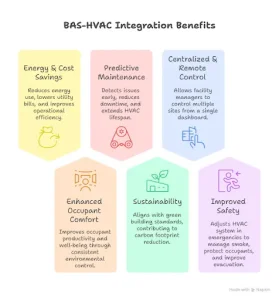
1. Energy & Cost Savings
BAS does help in reducing the building’s energy use by up to 30%. This directly translates into lowering the utility bills and even helping achieve higher operational efficiency.
2. Enhanced Occupant Comfort
Consistent humidity, temperature, and air quality do improve occupant productivity and well-being.
3. Predictive Maintenance
By timely monitoring the system performance, BAS helps detect possible issues early. This does reduce the equipment downtime and even extends the HVAC lifespan.
4. Sustainability
BAS aligns with the green building standards like LEED, further contributing to a carbon footprint reduction.
5. Centralized & Remote Control
Facility managers help control multiple sites right from a single dashboard, making it an ideal choice for hospitals, campuses, or airports.
6. Improved Safety
In case of emergencies, BAS can rightly adjust the HVAC system to manage smoke control, protect the occupants, and even improve evacuation safety.
Real-World Applications & Industry Adoption
Building Automation Systems are widely used in:
- Commercial buildings: For the cost savings that can be achieved instantly, and for comfort.
- Hospitals: Where precise air quality and nominal temperature maintenance remain critical.
- Airports: To effectively manage massive HVAC loads during any part of the day.
- Universities: To optimize the campus-wide building’s energy performance.
According to the U.S. Department of Energy and the ASHRAE, BAS adoption can certainly lower the operational costs by 20 to 30% annually. Global interoperability is supported by industry standards like BACnet, further making the integration process easier across manufacturers.
Future of BAS in HVAC Management
The role of BAS is certainly evolving:
- IoT & Cloud Integration: BAS now helps in connecting with IoT devices for real-time analytics and for cloud-based control.
- AI & Machine Learning: Predictive analytics can rightly forecast possible equipment failures, reduce manual adjustments, and even help optimize energy usage.
- Smart Cities & Net-Zero Buildings: BAS plays an integral part in net-zero energy goals, further contributing to greener and smarter urban infrastructure.
The combination of having smart HVAC management and automation helps achieve better comfort and also enhances the building’s sustainability for years.
Conclusion
Building Automation Systems have been rightly transforming the ways facilities tend to manage HVAC. By combining automation, intelligent control, and real-time data, BAS ensures comfort, efficiency, and sustainability are attained all throughout the year. BAS and HVAC integration is crucial as it directly reflects on the future of building management.
At Powerize Arabia, the most trusted HVAC company in AL JUBAIL, our experts help optimize your facility with systems that are designed following industry standards and maintained well for peak performance.
We are one phone call away to answer any of your queries related to HVAC management. Reach us now.
FAQs
1. What’s the difference between BAS and BMS?
BAS is a subset of BMS. While BMS manages all building systems, BAS often focuses on HVAC, lighting, and safety systems.
2. How much energy can BAS save in HVAC?
Studies show BAS can reduce HVAC energy use by 20 to 30% through smart scheduling and optimization.
3. Does a BAS require constant human monitoring?
No. BAS is designed for automation. Facility managers only need to intervene when alerts or unusual conditions occur.
4. Can BAS be installed in existing or older buildings?
Yes. Retrofits are possible, though they may require additional sensors, wiring, or protocol converters.
5. What challenges are involved in implementing a BAS for HVAC?
Challenges include high upfront costs, integration complexity, and the need for trained technicians. However, the long-term savings outweigh these concerns.