
A well-designed HVAC system performs better when it’s as good as its ductwork. The network of ducts tends to carry conditioned air to every connected room, further ensuring efficiency and comfort. If at all, the ductwork is poorly installed or designed, then significant energy losses can be experienced.
Studies do show that improper duct installation can waste about 20 to 40% of heating and cooling energy in a building. This further increases energy bills and also has a direct effect on comfort and indoor air quality.
This is where following industry standards from organizations like SMACNA, ACCNA, and ASHRAE must be given importance.
Keep reading as we explore more about ductwork installation processes and the best practices you can follow to achieve proper airflow distribution, long-term reliability, and high energy efficiency.
What is Ductwork Installation?
Ductwork installation involves the process of designing, assembling, sealing, and then rightly connecting the air duct system that effectively distributes cooled or heated air throughout the building.
It involves following careful planning, compliance with engineering standards, and proper material selection. Whether it’s for large-scale residential or large-scale commercial duct systems, proper installation has a direct impact on comfort, efficiency, and air quality.
Understanding the Ductwork Installation Process
1. Planning & Design
Every successful installation starts with proper planning.
- Experts make use of Manual D calculations to size ducts based on the airflow requirements.
- Every room gets analyzed for its cubic feet per minute (CFM) needs.
- Friction rates and static pressure are calculated alongside to avoid inefficiencies.
By following the ASHRAE guidelines, our in-house team of installation experts ensures achieving balanced airflow across all your rooms.
2. Material Preparation
Choosing the best type of duct material matters the most.
- Fiberglass ducts offer insulation, while the galvanized steel ducts are more durable, and following a flexible duct installation process is certainly useful for tight spaces.
Quality sealants, fittings, and supports get prepared before assembling them to avoid potential weak points.
3. Hanging Duct Supports
Ducts must have a proper support system.
- According to the SMACNA standards, supports must be placed at regular intervals to prevent vibration, sagging, and noise.
Poorly supported ducts can only lead to potential leaks, cracks, and reduced efficiency.
4. Assembling Duct Sections
The installation experts will align rigid ducts with precision, using cleats and snap-locks.
- Flexible ducts are widely used only for handling short connections, mainly to minimize airflow resistance.
Poorly joined or misaligned ducts can reduce the overall performance of the system.
5. Sealing Joints
Potential air leaks are one of the biggest efficiency losses that must be handled wisely during the installation process itself.
Other than using common duct tape, our team of experts makes use of mastic adhesives or UL-181 foil tape as recommended by the SMACNA sealing standards to properly seal the joints.
6. Installing Accessories
Balancing dampers help regulate airflow, and the fire dampers help enhance safety.
- Zoning dampers allow tailored comfort in different areas.
- Accessories like sound attenuators and access doors improve both comfort and maintenance.
7. Insulation
Uninsulated ducts tend to lose energy.
- In case of unconditioned spaces like attics, the duct needs to have at least R-6 insulation.
A continuous vapor barrier further prevents condensation and induced mold growth.
8. Connecting to HVAC Unit
The final part of the connection is made to the air handler, furnace, or AC unit. An airtight and secure connection ensures that the entire air duct system can deliver better airflow.
9. Registers & Grilles
Placement of grilles and registers does have an impact on comfort. They need to be positioned in a way to promote a well-balanced and proper airflow distribution all over the room.
10. Testing & Verification
Post the installation process, various tests need to be done to help confirm efficiency. These tests include thermographic scans, duct leakage tests, and airflow measurements to detect hidden leaks.
Our installation expert team can wisely handle all your system installation needs, and ensure that we follow the right industry standards to let the system provide better air flow without facing possible leaks and damage.
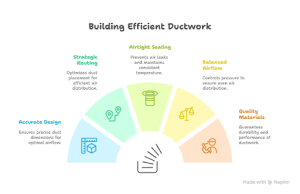
Five Essential Best Practices for Efficient Ductwork

a) Accurate Design & Sizing
- Using the Manual D method along with the ASHRAE guidelines.
- Performing a room-by-room type of load analysis.
- Ensuring the supply and return ducts are well-balanced.
- Preventing pressure drops, noise, and possible airflow restrictions.
b) Strategic Routing & Placement
- Keeping the runs short and straight with minimal bends.
- Avoiding any kind of unconditioned spaces, like attics and crawl spaces.
- Using rigid ducts for the main runs, and flexible ducts only for handling short connectors.
c) Airtight Sealing & Proper Insulation
- Sealing joints as per SMACNA standards.
- Applying UL-181 approved foil tape or mastic adhesive.
- Maintaining insulation with a minimum R-6 rating.
d) Balanced Airflow & Pressure Control
- Installing balancing dampers to adjust the flow correctly.
- Maintaining neutral building pressure.
- Considering zoning systems for larger buildings or home spaces.
- Monitoring static pressure to effectively avoid equipment strain.
e) Quality Materials & Craftsmanship
- Round ducts are said to be more efficient when compared to the rectangular ones.
- Galvanized steel helps in achieving utmost durability.
- Only licensed contractors are allowed to install ducts that can comply with the local codes, NFFA fire safety standards, and best practices.
Common Installation Considerations
- Location: Ducts need to be within the conditioned envelope of the building to help reduce potential energy losses.
- Leakage Risks: Poor sealing can result in reducing the system’s efficiency by 20 to 30%.
- Aesthetics: Exposed ductwork can help enhance modern commercial interiors, if at all they have been installed neatly.
- Indoor Air Quality (IAQ): Proper sealing prevents mold, dust, and contaminants from entering the air supply.
- DIY vs. Professional: While the minor sealing can be DIY, the full installation process must be handled by certified professionals and experts representing the best ductwork company.
Post-Installation Testing & Commissioning
The post-installation testing process ensures the ducts are optimized to achieve better efficiency. Key steps include:
- Duct leakage tests are performed with a blower door or duct blaster.
- Static pressure measurement taken to better understand airflow.
- Thermographic imaging is done to detect potential hidden leaks.
- Room comfort checks are mostly performed for maintaining consistent temperature and airflow.
- Commissioning documentation as per the SMACNA and the ASHRAE standards.
The Role of Professionals in Ductwork Installation
Hiring ductwork installation services from a professional HVAC company not only saves your time and money but also helps in creating a system that performs better and lasts longer. Certified contractors do possess a wide knowledge of:
- Manual D sizing methods.
- The SMACNA and the ASHRAE standards.
- NFPA fire safety codes.
- Zoning and pressure balancing techniques.
Professional ductwork services help ensure safety, compliance, and achieve long-term efficiency. While the DIY approach might save on your upfront costs, any kind of poor installation can only lead to higher energy bills and expensive repairs.
A study conducted recently showcases the fact that professional sealing and testing can certainly save up to 30% of your HVAC energy use.
Conclusion
Proper ductwork installation remains the foundation of having an energy-efficient and airflow-friendly building. Following the best practices in terms of design, sealing, insulation, and testing further ensures achieving reliable performance and long-term savings.
When the ducts are installed with precision, businesses and homeowners can reduce energy losses up to 40%, enjoy consistent comfort, and improve indoor air quality, all in one place.
At Powerize Arabia, our licensed HVAC contractors are here to help in designing, installing, and testing ductwork to achieve maximum performance.
Choosing our professional services ensures that all your investment made toward HVAC only delivers comfort, efficiency, and safety for years to come.
FAQs
1. Why are round ducts more efficient than rectangular ones?
Round ducts create less friction, which allows air to flow more smoothly and efficiently.
2. How do zoning systems improve comfort?
Zoning uses dampers to control airflow separately in different areas, preventing hot and cold spots.
3. Can leaky ducts affect indoor air quality?
Yes. Leaks can draw in dust, pollutants, and mold from attics or crawl spaces, further hindering the air quality.
4. How often should ducts be tested for leakage?
Experts recommend testing ducts every 3 to 5 years or after performing major renovations.
5. Can duct cleaning improve HVAC efficiency?
Regular cleaning removes dust buildup, but sealing and insulation have a much greater impact on efficiency.