


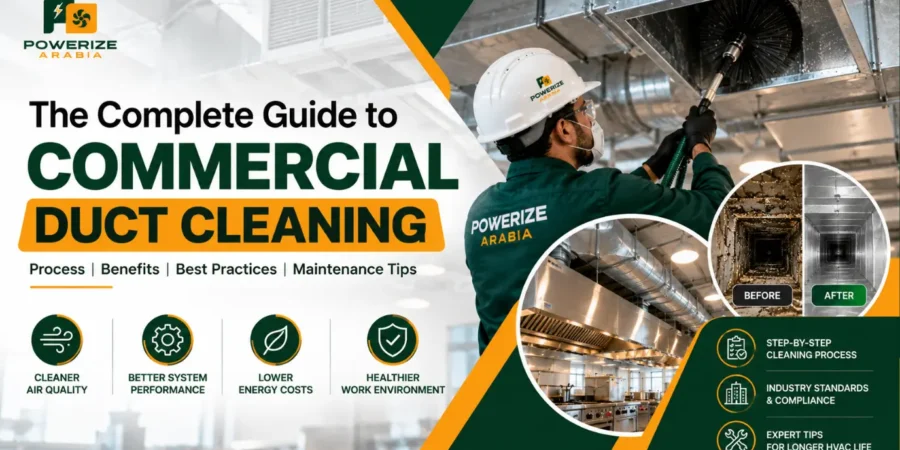
Every commercial building breathes through its ductwork. Offices, malls, hospitals, hotels, and factories all rely on the same hidden network of ducts to move conditioned air into the spaces people occupy. When that network is clean, nobody notices it. When it is clogged with dust, debris, and moisture, it quietly drags down air quality, pushes up energy bills, and strains the HVAC system until something fails.
Commercial duct cleaning is how you keep that from happening. This guide pulls together everything a facility owner or manager needs to know, from why it matters and what the process involves to how often it should be done, what standards apply, and how to choose a provider you can trust. Think of it as the starting point, with links to deeper reading on each topic along the way.
What Is Commercial Duct Cleaning?
Commercial duct cleaning is the professional removal of dust, debris, allergens, and contaminants from the ductwork and connected components of a building’s heating, ventilation, and air conditioning system. It covers the supply and return ducts, registers, grilles, and diffusers, and the components at the air handler such as coils, drain pans, and fans.
It is not the same as a quick vacuum of the vents you can see. A proper cleaning addresses the entire airside surface of the system, because contaminants sitting deep in the ducts are exactly the ones that keep circulating into occupied spaces. The difference between a thorough job and a cosmetic one is large, which is why it helps to understand how to know if your commercial duct cleaning was done properly before you sign off on any work.
Why Commercial Duct Cleaning Matters
The case for keeping ductwork clean comes down to three things: the air people breathe, the money you spend, and the life of your equipment.
Healthier indoor air. Dust, pollen, mould spores, and other particles collect inside ducts and get pushed back into the building every time the system runs. For a workplace, that shows up as more allergy complaints, more sick days, and a less comfortable environment. The link is direct enough that it is worth reading our full breakdown of duct cleaning and indoor air quality, and specifically why commercial duct cleaning is essential for employee health.
Lower energy costs. When dust coats ducts, coils, and blower components, the system has to work harder to move and condition the same volume of air. That extra effort shows up on the utility bill. Cleaning restores airflow and heat transfer, which is covered in detail in our guide on how duct cleaning helps reduce energy consumption. The U.S. Environmental Protection Agency treats proper HVAC upkeep as part of maintaining a healthy, efficient building.
Longer equipment life and fewer breakdowns. A system running against less internal grime experiences less strain, which helps it reach its expected service life rather than failing early. In a hot, dusty climate, that margin matters even more.
Signs Your Building Needs Duct Cleaning
Ductwork rarely announces that it needs attention, but the warning signs are consistent once you know them. Common red flags include:
- Visible dust blowing from supply vents, or dust settling quickly after cleaning
- Persistent stale or musty odours with no obvious source
- Uneven airflow, with some areas poorly served despite the system running
- A rise in allergy or respiratory complaints among occupants
- Visible mould near vents, coils, or inside accessible ductwork
- Recent renovation or construction that filled the system with fine debris
If several of these overlap, it is time to act. Our dedicated post on the 5 warning signs your air ducts need cleaning walks through each one and what it points to.
The Commercial Duct Cleaning Process
A professional cleaning follows a structured sequence rather than a single pass with a vacuum. While details vary by building, a thorough process generally moves through these stages:
- Inspection and assessment. Technicians examine the system, often with cameras, to document the real condition of the ducts and components and set the scope of work.
- Containment and protection. Registers and surrounding areas are sealed and protected so loosened debris cannot escape into occupied spaces.
- Source removal under negative pressure. The section being cleaned is placed under continuous negative pressure while agitation tools dislodge debris, so contaminants are drawn out rather than scattered.
- Component cleaning. Coils, drain pans, fans, registers, and grilles are cleaned, because leaving these dirty lets them re-contaminate freshly cleaned ducts within days.
- Verification and documentation. The result is inspected and documented, ideally with before-and-after evidence.
The use of HEPA-filtered vacuum equipment is central to doing this safely. HEPA filtration captures very fine particles rather than blowing them back into the air, which is why it is a baseline requirement for serious work. The industry framework for all of this is the ACR Standard published by the National Air Duct Cleaners Association (NADCA), the recognised benchmark for assessing, cleaning, and verifying HVAC systems.
How Often Should Commercial Ducts Be Cleaned?
There is no single number that fits every building, because the right interval depends on what the building does and the conditions it sits in. A quiet office and a busy food-processing plant have completely different needs.
The factors that shorten the interval include high occupancy, dust-heavy surroundings, industrial processes, humidity, and any recent construction. In a hot, dusty region like Saudi Arabia’s Eastern Province, fine airborne dust accumulates faster than schedules designed for milder climates assume, so many facilities clean more often than the baseline. Because the answer is so industry-specific, we have broken it down separately in our duct cleaning frequency guide for different industries.
Clean Ductwork Starts With Good Installation
An important point that is easy to miss: the easiest ductwork to keep clean is ductwork that was installed well in the first place. Poorly designed or badly sealed ducts trap debris, leak conditioned air, and are harder to access and clean. Getting the fundamentals right pays off for years, which is why it is worth understanding ductwork installation best practices for efficient HVAC systems and how proper AC duct installation reduces electricity bills. Clean air and low bills both start upstream, at the design and installation stage.
The Benefits of Commercial Duct Cleaning at a Glance
Pulling it together, a well-executed cleaning programme delivers:
- Cleaner, healthier indoor air and fewer occupant complaints
- Lower energy consumption from restored airflow and heat transfer
- Longer equipment life and fewer unplanned breakdowns
- Better compliance and documentation for audits and certifications
- A more comfortable, productive environment for the people inside
For the full picture of what cleaning returns to a building, see our overview of the importance and benefits of air duct cleaning.
How to Choose a Commercial Duct Cleaning Provider
This is where many building owners get burned, because the work happens out of sight and a poor job looks identical to a good one until the problems surface later. A few questions separate a professional from a cut-rate operator:
- Do they follow a recognised standard such as the NADCA ACR Standard, and can they explain their process?
- What do they actually clean? The answer should include ducts, registers, and air-handler components, not just the visible vents.
- What equipment do they use? Look for negative-pressure, HEPA-filtered source removal, not a shop vacuum.
- Do they inspect and document before and after, with photos?
- Are they certified, insured, and able to prove it?
Certification is a strong signal because it is voluntary, so a company that invests in it is holding itself to a documented benchmark. Our post on the benefits of choosing a certified HVAC air duct cleaning company explains why this matters more than a low headline price.
Frequently Asked Questions
1. What does commercial duct cleaning include?
A complete service covers supply and return ducts, registers and grilles, and accessible air-handler components such as coils, drain pans, and fans. Cleaning only the visible vents is not a full service.
2. How often should commercial ducts be cleaned?
It depends on the building type, occupancy, and environment. Dusty or high-traffic facilities need more frequent attention, and conditions in the Eastern Province often push intervals shorter than standard guidance suggests.
3. Does duct cleaning really lower energy bills?
Yes. Removing debris from ducts, coils, and blower components restores airflow and heat transfer, so the HVAC system does not have to work as hard to maintain conditions.
4. Can duct cleaning improve indoor air quality?
It can, when done properly. Removing accumulated dust, allergens, and mould from the system means less of it is recirculated into occupied spaces, which supports healthier air and fewer complaints.
5. How do I know the job was done properly?
A professional provider inspects and documents before and after, uses HEPA-filtered source removal, and cleans the whole system rather than just the vents. Before-and-after evidence is your proof.
6. Is commercial duct cleaning worth the cost?
For most buildings, yes. The combination of healthier air, lower energy use, fewer breakdowns, and longer equipment life usually outweighs the cost of a professional cleaning, especially in demanding climates.
Breathe Easier With a Cleaner System
Commercial duct cleaning is one of those investments that quietly pays for itself, through healthier air, lower bills, and equipment that lasts. The key is treating it as a documented, standards-based process carried out by a provider you can verify, not a quick pass with a vacuum.
If you manage a commercial or industrial facility in the Eastern Province, Powerizearabia provides a professional Duct Cleaning service in Al Jubail and the surrounding region, covering the full system with proper equipment, clear reporting, and before-and-after documentation. Get in touch with Powerizearabia to arrange an inspection and a cleaning plan built around your building.






2 Comments
Duct Cleaning vs Duct Sanitization: What's the Difference? - Powerize Arabia
[…] vents. If you want the full picture of what a professional service covers from start to finish, our complete guide to commercial duct cleaning walks through every […]
Duct Cleaning vs Duct Sanitization: What's the Difference?
[…] vents. If you want the full picture of what a professional service covers from start to finish, our complete guide to commercial duct cleaning walks through every […]