

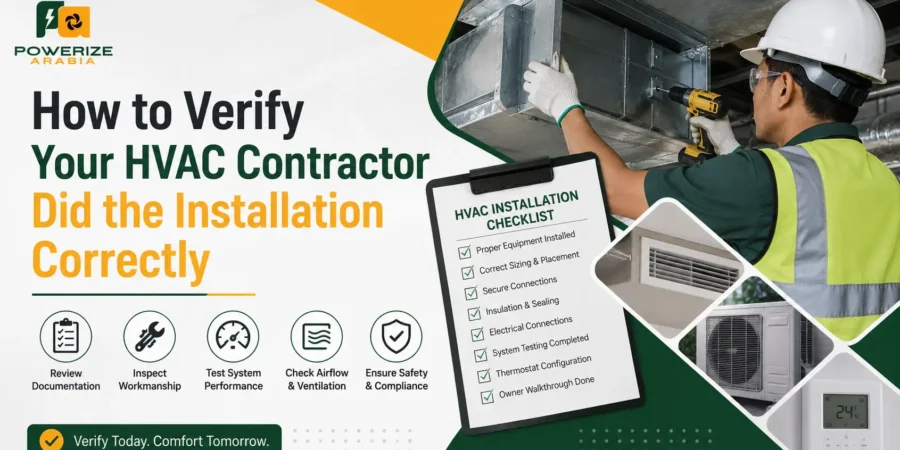
A bad HVAC installation doesn’t fail immediately. It fails quietly by way of rising energy bills, uneven temperatures, short equipment lifespan, and comfort complaints that start three months after the contractor left. By then, getting accountability is harder.
The equipment is rarely the issue. Studies consistently show that most high-efficiency HVAC systems fail to deliver their rated performance because of installation errors, not manufacturing defects. Knowing what to check, and when to check it, is the only way to protect a significant capital investment.
Here’s what to verify, in order.
1. Was the System Properly Sized Before Installation Began?
This is the question most building owners never ask and that’s the one that matters most.
Proper commercial HVAC sizing requires a load calculation (Manual J for residential, ASHRAE methods for commercial) that accounts for building envelope, occupancy, solar gain, ventilation requirements, and internal heat loads. Sizing a system based on square footage alone, or by matching the previous unit’s tonnage, almost always produces the wrong result.
What happens when sizing is wrong:
| Scenario | Short-Term Symptom | Long-Term Damage |
|---|---|---|
| Oversized system | Short cycling, humidity stays high | Compressor wear, premature failure |
| Undersized system | Can’t meet setpoint on peak days | Continuous overload, high energy bills |
| Correct sizing | Stable temperatures, proper dehumidification | Full equipment lifespan |
Ask your contractor for the load calculation report before installation starts. If they can’t produce one, that’s a problem worth addressing before the equipment goes in Not after.
2. Check the Ductwork Connections and Sealing
New equipment connected to poorly sealed ductwork is one of the most common installation mistakes in commercial buildings. Up to 30% of conditioned air can be lost through duct leaks at joints, poorly made connections, or unsealed access points before it ever reaches the occupied space.
Walk the accessible ductwork and look for:
- Joints wrapped in tape only and mastic sealant should be applied at all connections
- Visible gaps between duct sections or at AHU connections
- Flexible duct that’s kinked, sagging, or compressed
- Missing insulation on supply runs through unconditioned spaces
- Any sections that were cut or moved during installation and not properly reinstalled
A reputable HVAC company performs duct leakage testing after installation rather than visual inspection. Ask for the test results. The acceptable leakage rate for commercial systems is typically less than 5% of total system airflow.
3. Verify Refrigerant Charge Was Set Correctly
Factory refrigerant charges in new equipment are baseline starting points, not final calibrations. Every installation requires field verification once the system is running in its actual environment.
Proper refrigerant commissioning involves:
- Superheat and subcooling measurements confirming the charge is appropriate for operating conditions
- Temperature split testing measuring the difference between supply and return air temperature at the AHU should fall within the manufacturer’s specified range (typically 14–22°F / 8–12°C)
- Operating pressure readings with both suction and discharge pressures logged against manufacturer specs for ambient conditions
An overcharged or undercharged system runs less efficiently and stresses the compressor. The performance difference between correct and incorrect charge can be 15–25% on energy consumption. Ask for a commissioning report that includes these measurements and if none was done, the system was not properly commissioned.
4. Confirm Airflow Was Measured and Balanced
This step gets skipped more than almost any other, partly because the equipment required (a calibrated flow hood) is specialised and not every contractor owns one.
Every supply register in a commercial installation should be delivering airflow within 10–15% of the design specification. When airflow is unbalanced:
- Some zones are overcooled while others can’t reach setpoint
- The system runs longer to compensate, increasing energy use
- Static pressure builds, which reduces equipment efficiency and increases fan motor wear
What to ask your contractor:
- Was a flow hood used to measure CFM at each register?
- Were dampers adjusted to balance airflow across zones?
- Were fan speeds set to manufacturer specifications, not just default settings?
If the answer to any of these is no or uncertain, request that airflow balancing be completed before final sign-off.
5. Inspect the Outdoor Unit Installation
The condensing unit or chiller placement affects long-term performance and maintenance access. A rushed installation often cuts corners here.
Check the following:
- Unit is level and unlevel condensers cause refrigerant distribution issues and vibration
- Adequate clearance on all sides with a minimum 600mm from walls or obstructions on most units, check manufacturer specs
- Vibration isolators or anti-vibration pads installed beneath the unit
- Condensate drain lines pitched correctly so water flows away from the building
- Electrical disconnects accessible and properly labelled
- Refrigerant lines insulated along their entire run, including at penetrations
A unit sitting directly on concrete without isolation pads, or positioned where exhaust air recirculates back into the intake, will run harder and wear out faster.
6. Watch for Short Cycling in the First Two Weeks
Short cycling where the system starts, runs briefly, then shuts off is one of the clearest signs something is wrong with the installation. Normal commercial HVAC cycles run 10–20 minutes depending on load. Cycles under 5 minutes indicate a problem.
Common causes:
- Oversized equipment that satisfies the thermostat setpoint before the system has fully ramped up
- Incorrect refrigerant charge causing the system to trip on high pressure
- Airflow restriction from dirty filters, blocked registers, or duct problems
- Faulty thermostat wiring or incorrect control settings
Document the behaviour noting the time, duration of on/off cycles, and ambient conditions. This data is useful if you need to hold the contractor accountable under warranty.
7. Review the Commissioning Documentation
A properly completed HVAC installation generates paperwork. If the contractor hands you only a receipt and a warranty card, the commissioning process was either skipped or not documented.
What a complete handover package should include:
- Load calculation report
- Equipment model numbers, serial numbers, and warranty registration confirmation
- Refrigerant charge log (type, quantity added, superheat/subcooling readings)
- Airflow measurements at each register
- Duct leakage test results
- Thermostat programming settings
- As-built drawings showing equipment locations and ductwork changes
- Any permits pulled and inspection sign-offs
The commissioning documentation is also your baseline for future maintenance. Powerize Arabia provides full commissioning reports on every commercial HVAC installation and these documents become the reference point for every maintenance visit that follows, which is what proper asset management looks like.
Red Flags That Suggest a Poor Installation
| Warning Sign | What It Likely Means |
|---|---|
| No load calculation performed | Equipment probably wrong size |
| Installation completed in one day for a large system | Steps were skipped |
| No refrigerant log provided | Charge was not properly verified |
| Airflow not measured at registers | System not balanced |
| Condensate draining toward building | Drain line pitched incorrectly |
| No permits pulled | Work may not meet local code |
| Contractor unavailable after handover | Warranty support will be difficult |
| Thermostat left on factory defaults | System not configured for the building |
Frequently Asked Questions
1. How soon after installation can I tell if something was done wrong?
Some issues show up within days: short cycling, unusual noise, or a system that can’t reach setpoint. Others take weeks or months: humidity problems, uneven zones, and rising energy bills often develop as seasonal conditions change. The first 60 days are the most important window for catching installation errors under warranty.
2. What is commissioning and is it required?
Commissioning is the process of testing, adjusting, and verifying that an installed system performs to design specifications. It’s not always legally required, but any HVAC installation completed without it should be considered incomplete. For commercial buildings, commissioning is standard practice and often required for green building certifications like LEED.
3. Can I verify the installation myself, or do I need another contractor?
Basic checks like visual inspection of connections, listening for short cycling, and checking that all registers have airflow don’t require tools. But refrigerant charge verification and airflow measurement require calibrated equipment. If you have concerns, an independent commissioning engineer or a second HVAC company can conduct a post-installation audit.
4. What if the original contractor disputes my findings?
Document everything before raising a dispute: photos, measured temperatures, energy bills, cycle timing. Check whether permits were pulled and whether inspections were completed. In many cases, a failed inspection creates a clear record. If the contractor is unresponsive, a formal dispute through your contract or a professional body is the next step.
5. Does HVAC installation quality affect my warranty?
Yes, directly. Most manufacturer warranties require that equipment be installed by a licensed contractor and that refrigerant charge and airflow meet specifications. A system installed incorrectly may void the equipment warranty, leaving you with no manufacturer recourse when components fail early.
6. What standards should a commercial HVAC installation meet?
In the GCC, installations should comply with ASHRAE standards for load calculation and energy efficiency, local civil defence requirements for fire dampers and ventilation, and manufacturer commissioning specifications. Ask your contractor which standards they follow and whether the installation was inspected by a qualified engineer.
Conclusion
A new HVAC system is one of the largest operational investments a commercial building makes. The frustrating reality is that most performance problems trace back to installation not equipment failure, and most of those problems were avoidable with the right checks at the right time.
To recap what matters most:
- Sizing demand a load calculation report, not a square footage estimate
- Ductwork inspect sealing, insulation, and get a leakage test result
- Refrigerant charge ask for superheat, subcooling, and temperature split readings
- Airflow confirm registers were measured with a flow hood and balanced
- Outdoor unit check levelness, clearances, and condensate drainage
- Short cycling monitor the first two weeks and document any abnormal behaviour
- Documentation a full commissioning package is non-negotiable before final sign-off
If your contractor can’t produce paperwork for most of the above, you have no reliable way to know what was actually done or what to reference when something goes wrong later.
Working with a contractor who treats commissioning as standard practice, not an optional extra, is the difference between a system that performs for 15 years and one that starts causing problems in year three. If you’re planning a commercial HVAC installation or want an independent review of a recently completed one, Powerize Arabia can assess the installation against commissioning standards and provide documented findings you can act on.