

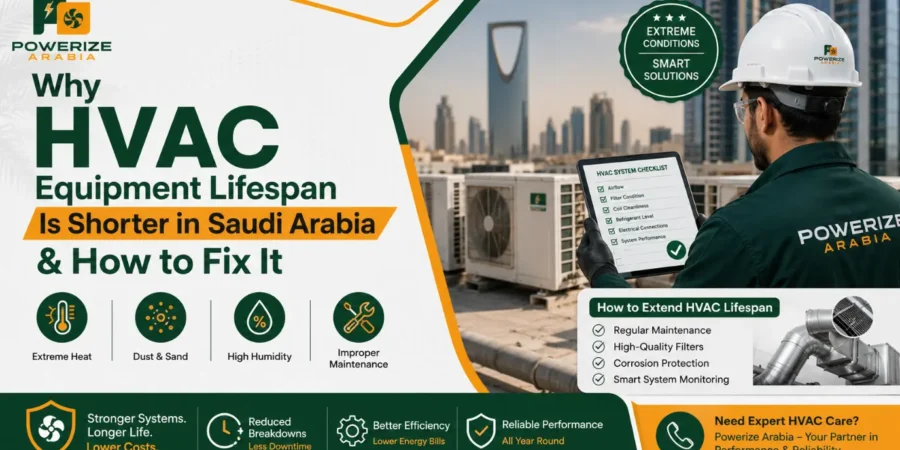
A cooling system that comfortably reaches 15 years in a mild climate often struggles to hit 10 in the Kingdom. Anyone managing a villa in Riyadh, a tower in Jeddah, or a warehouse in Dammam has felt it: units fail sooner, repairs pile up faster, and replacement cycles arrive years ahead of the brochure promise.
This guide explains why HVAC lifespan in Saudi Arabia is shorter, backed by the numbers every facility manager and HVAC contractor works with — then lays out exactly how to fix it.
The Global HVAC Lifespan Benchmark (Your Starting Point)
Before explaining why Saudi conditions shorten equipment life, here are the internationally accepted baselines. These are the numbers manufacturers and facility guides quote for temperate, well-maintained installations.
| Equipment | Metric | Global Benchmark |
| Central air conditioner | Average lifespan | 12–17 years |
| Heat pump | Average lifespan | 10–16 years |
| Boiler | Average lifespan | 15–30 years |
| Rooftop unit (RTU) | Average lifespan | 15–20 years |
| Chiller | Average lifespan | 15–25 years |
| Air handler | Average lifespan | 15–20 years |
| Condenser | Average lifespan | 10–20 years |
| Ductwork | Average lifespan | 20–25 years |
| Commercial HVAC system (overall) | Average lifespan | 15–20 years |
Two more baselines worth remembering:
- Leaky ductwork → energy loss → up to 30%. Even a healthy unit underperforms if the ducts leak.
- Maintenance → lifespan impact → single biggest controllable factor. Across residential and commercial guidance, routine servicing is the top lever for longevity.
These ranges assume mild climate and proper installation. Saudi Arabia is neither mild nor forgiving — which is where the gap opens.
Why HVAC Lifespan in Saudi Arabia Is Shorter
Climate and usage are openly cited as major lifespan factors: systems battling extreme weather in harsh environments face far more stress than those in mild ones. Saudi Arabia stacks five stressors at once, and each one attacks a different part of the machine.
1. Extreme Heat & Near-Constant Runtime
| Factor | Detail | Impact |
| Saudi summer | Peak ambient temperature | 45–50°C+ in inland cities |
| Cooling season | Effective duration | ~8–10 months per year |
| Compressor | Effect of high heat + long runtime | Accelerated wear, shorter life |
A compressor rated for seasonal duty in Europe runs almost year-round in the Kingdom. More runtime means more start-stop cycles, more heat rejection stress, and faster mechanical fatigue. Heavy use increases wear and tear and directly decreases lifespan.
2. Dust, Sand & Airborne Fines
| Factor | Detail | Impact |
| Desert dust/sand | Effect on condenser coils | Clogging → poor heat rejection |
| Sand accumulation | Effect on airflow | Restricted airflow → overheating |
| Clogged filters | Effect on system | Harder workload → premature burnout |
A clogged filter forces the system to work harder to pull air through, leading to overheating and burnout. In dusty regions this happens far faster — filters and coils that a US homeowner checks every 1–3 months may need attention monthly or sooner.
3. Coastal Salt & Humidity (Jeddah, Dammam, Khobar)
| Factor | Detail | Impact |
| Coastal salt air | Effect on coils & cabinets | Corrosion → early metal failure |
| High humidity | Effect on components | Moisture, mold, insulation breakdown |
| Ductwork + moisture/mold | Effect on lifespan | Degrades earlier than the 20–25 yr norm |
Salt-laden air corrodes fins, cabinets, and electricals. Ductwork exposed to moisture or mold degrades ahead of schedule, and once insulation deteriorates, efficiency drops even while the unit still “works.”
4. Installation Quality & System Sizing
| Factor | Detail | Impact |
| Precision installation | Effect on lifespan | Sets stage for full-length service life |
| Poor installation | Effect on lifespan | Accelerates wear |
| Undersized system | Effect under Saudi load | Constant strain → higher wear |
Whether a unit reaches the high end of its range often comes down to install quality. Under a 50°C load, an undersized or poorly commissioned system never gets to rest — and pays for it in years lost.
5. Power & Water Conditions
| Factor | Detail | Impact |
| Voltage fluctuations | Effect on electronics | Stress on boards, motors, compressors |
| Hard water / scaling | Effect on chillers & coils | Reduced efficiency, faster fouling |
Modern HVAC systems increasingly rely on electronics and variable-speed motors — and electronics are among the first things to fail under unstable power. Scaling from hard water compounds the problem in water-cooled and chiller-based commercial setups.
Saudi-Adjusted Lifespan: What to Realistically Expect
Combine the five stressors above and the practical outcome is simple: equipment tends to land at the low end of its global range — or below it. Use these adjusted expectations for planning, not as guarantees.
| Equipment | Metric | Realistic in KSA |
| Split / central AC | Practical service life | Low end of 12–17 yrs, often ~8–12 |
| Heat pump | Practical service life | Low end of 10–16 yrs |
| Rooftop unit (RTU) | Practical service life | Low end of 15–20 yrs |
| Coastal-installed units | Corrosion-driven life | Below inland equivalents |
| Neglected (no maintenance) | Lifespan outcome | Sharply reduced, early failure likely |
The pattern is consistent: harsh climate pulls every number down, and the difference between a well-maintained and a neglected unit in Saudi Arabia can be measured in years.
Warning Signs Your System Is Aging Prematurely
Catch these early and you avoid an emergency failure in peak summer — the worst possible time to lose cooling.
- Rising energy bills → cause → efficiency loss. Costs climb with no change in usage.
- Inconsistent temperatures → cause → poor air distribution. Hot and cold spots across rooms or floors.
- Strange noises → cause → mechanical fault. Grinding, rattling, squeaking.
- Short cycling → cause → system struggling. Frequent start-stops.
- Rising humidity / poor airflow → cause → declining performance.
- Frequent service calls → cause → cumulative wear. Repairs stacking up.
- Age past 15 years + frequent faults → signal → replacement usually more cost-effective.
How to Fix It: 7 Ways to Extend HVAC Lifespan in Saudi Arabia
The goal is to push equipment back toward the high end of its range despite the climate. Every fix below maps directly to one of the stressors above.
1. Commit to Routine, Climate-Aware Maintenance
Maintenance is the single biggest controllable factor in lifespan. In Saudi conditions, schedule professional check-ups quarterly or at the start of each cooling season, not just once a year. Pros catch loose connections, worn belts, and refrigerant issues before they cascade.
2. Change & Clean Filters More Often Than the Manual Says
The global advice is every 1–3 months. In dusty inland cities, inspect monthly. Clean filters keep airflow smooth and stop the system from overheating.
3. Clean Condenser & Evaporator Coils
Dust and sand blanket coils and kill heat rejection. Regular coil cleaning — plus clearing debris from outdoor units — restores efficiency and prevents the overheating that shortens compressor life.
4. Protect Against Corrosion in Coastal Zones
For Jeddah, Dammam, and Khobar installs, prioritise corrosion-resistant coils/cabinets and rinse salt residue during servicing. This directly counters the coastal-air stressor.
5. Inspect & Seal Ductwork
Leaky ducts waste up to 30% of energy. Inspect for leaks and insulation gaps; in large buildings, ductwork can be replaced in phases during scheduled downtime to spread cost and limit disruption.
6. Stabilise Power & Manage Water
Protect electronics from voltage swings, and address hard-water scaling on chillers and water-cooled equipment to keep efficiency up and fouling down.
7. Right-Size and Install with Precision
A correctly sized, professionally commissioned system doesn’t run flat-out against a 50°C load. Good installation sets the stage for full-length service life; poor installation guarantees the opposite.
Repair vs. Replace: When to Stop Fixing
At some point another repair stops making sense. Use these decision triples:
| Situation | Signal | Decision Rule |
| Repair cost vs. replacement cost | Threshold | Repair > 50% of replacement → replace |
| System age | Threshold | Over 15–20 yrs + major issues → replace |
| Old system efficiency | Running cost | Lower SEER → higher running cost |
| New system | Benefit | Variable-speed motors, smart controls, better zoning |
Replacing an aging unit with a modern, efficient one often lowers monthly bills enough to offset much of the upgrade — especially relevant given Saudi Arabia’s long, hot cooling season.
Frequently Asked Questions
1. How long does an AC actually last in Saudi Arabia?
Global benchmarks put central AC at 12–17 years, but Saudi heat, dust, and coastal conditions typically pull real-world life toward the low end — commonly around 8–12 years, and less without maintenance.
2. Does maintenance really make a difference in this climate?
Yes. Routine maintenance reduces mechanical stress and keeps components clean, adding several years of life and preventing expensive peak-summer breakdowns. In harsh climates the payoff is even larger.
3. Why do coastal units fail faster than inland ones?
Salt-laden humid air corrodes coils, cabinets, and electricals, so coastal installations generally reach the end of their service life earlier than inland equivalents unless corrosion protection is used.
4. How often should I service HVAC in Saudi Arabia?
Quarterly or at the start of each cooling season is a safe target, with monthly filter checks in dusty inland areas — more frequent than the once-a-year advice common in mild climates.
5. When is replacement smarter than repair?
When repair costs exceed roughly 50% of replacement cost, the unit is past 15–20 years with major faults, or bills keep climbing despite repairs.
The Bottom Line
Saudi Arabia doesn’t break the rules of HVAC lifespan — it stress-tests them. Extreme heat, near-year-round runtime, desert dust, coastal salt, unstable power, and installation shortcuts each shave years off equipment that would otherwise last well over a decade.
The fix isn’t complicated, just consistent: maintain more often, protect against dust and salt, seal your ducts, right-size your system, and replace on the numbers, not on hope. Do that, and you push your equipment back toward the top of its range — even under a Kingdom summer.
For site-specific advice, have a qualified HVAC contractor assess your equipment, climate zone (inland vs. coastal), and usage load before you commit to repair or replacement.
Extend Your HVAC Lifespan with PowerizeArabia Limited Company
Fighting Saudi heat, dust, and coastal salt takes a partner who knows the local conditions. PowerizeArabia Limited Company is an experienced HVAC contractor delivering climate-aware maintenance, corrosion protection, ductwork sealing, and right-sized installations built to survive the Kingdom’s summers. Whether you run a villa in Riyadh, a tower in Jeddah, or a facility in Dammam, PowerizeArabia helps you push equipment back toward the top of its lifespan range — and decide confidently when it’s time to repair or replace.