
If the technicians finished the job in under two hours and left without any paperwork, your ducts are most likely still dirty.
A proper commercial duct cleaning on a mid-sized building takes a minimum of four to eight hours. The job involves cutting access panels, using negative pressure extraction equipment, cleaning every register, and addressing key HVAC components beyond just the duct runs. When that process gets rushed or skipped, the debris does not get removed. It gets redistributed. Air quality gets worse, energy consumption goes up, and you have no documentation to prove the work was done.
Here is exactly how to verify the job was completed correctly.
Check the Equipment Before Work Begins
The equipment a duct cleaning company brings tells you immediately whether they can do the job properly.
Commercial duct cleaning requires a negative air pressure system powerful enough to create suction across the entire duct network simultaneously. This forces loosened debris toward collection points rather than pushing it further into the system. Without this equipment, agitation methods simply move contamination from one section to another.
| Equipment Type | Adequate for Commercial? | Notes |
|---|---|---|
| Truck-mounted vacuum unit | Yes | Industry standard for large buildings |
| Portable negative air machine (2,000+ CFM) | Yes | Acceptable when correctly sized |
| Standard portable shop vacuum | No | Residential grade, insufficient suction |
| Handheld blower without extraction | No | Moves debris, does not remove it |
If the crew arrived with shop vacuums or handheld equipment only, the ductwork surface may have been disturbed but the contamination was not extracted.
Access Panels Must Be Cut
This is one of the clearest indicators of whether a commercial duct cleaning was completed properly or not.
Accessing the internal sections of a duct system requires cutting access panels into the sheet metal, typically near the air handling unit and at key points along the main duct runs. These openings allow vacuum hoses and agitation tools to reach deep into the system rather than just treating areas visible from register openings.
What to verify on-site:
- Were access panels actually cut into the ductwork? If not, the cleaning was surface level.
- After the job, are all access holes sealed with sheet metal patches and mastic sealant?
- Is tape the only sealant used? Tape-only repairs fail within months, causing conditioned air to leak into ceiling voids and increasing energy bills significantly.
In 2025, NADCA updated its ACR standard to reinforce that proper access point creation is a required step, not optional, for any complete system cleaning. If your provider skips this, they are not meeting the industry standard.
Every Register and Grille Must Come Off
A thorough cleaning covers every supply and return register in the building, not just the ones in high-traffic or visible areas. Registers in storage rooms, server rooms, stairwells, and corridors accumulate just as much contamination as those in open office areas.
Walk through the building after the job. Dust rings around reinstalled grilles are a clear indicator the covers were never removed. Clean grilles reinstalled over dirty openings means nothing inside was touched.
The HVAC Components Beyond the Ducts
Ductwork is only part of the system. A complete commercial duct cleaning should also address the components that contaminate the duct network in the first place.
Components that must be included in scope:
- Evaporator coils: Fouled coils are a primary source of musty odours and biological growth. Cleaning the ducts while leaving dirty coils in place means the system recontaminates itself within weeks.
- Drain pans: Standing water in drain pans allows mould and bacteria to grow and circulate through the air supply continuously.
- Blower fan and housing: A contaminated blower wheel pushes debris back into freshly cleaned ductwork every time the system runs.
- Air handling unit interior: The AHU is where most of the contamination originates. Skipping it makes the duct cleaning only partially effective.
If the scope of work excluded these components, request a separate service record or insist they are included before paying the balance.
Post-Cleaning Visual Inspection
Within 24 to 48 hours of the cleaning, conduct a visual inspection before accepting the job as complete.
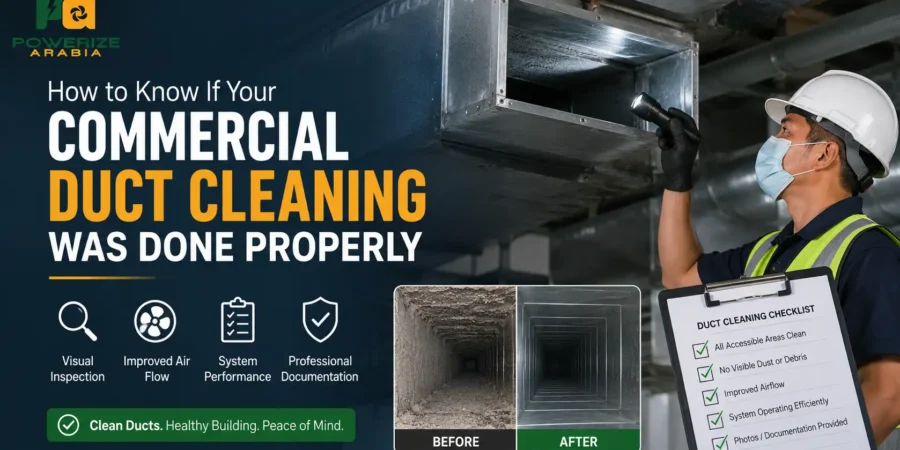
Remove the covers from three or four registers in different zones of the building. Use a torch or phone camera to look inside.
Signs the job was done correctly:
- Sheet metal interior is visibly clean with no dust mat on the duct floor
- No debris clumps or accumulation within the first 30 to 40 cm of the duct run
- No visible mould patches in sections that were flagged during pre-cleaning inspection
Signs the job was not completed properly:
- Loose dust or debris still sitting on internal duct surfaces
- Visible buildup along the duct floor or side walls
- Odour from the vent unchanged from before the cleaning
Airflow and Comfort Should Improve
Airflow improvement is one of the most noticeable outcomes of a properly completed duct cleaning. Building occupants tend to notice it within a few days.
Signs that the cleaning made a genuine difference:
- Less dust settling on surfaces near supply registers within the first week
- Fewer complaints about stuffy air or temperature inconsistencies between zones
- Filters reaching their replacement interval at the expected rate rather than loading unusually fast
If filters are clogging noticeably faster in the weeks after the cleaning, it often means debris was dislodged but not fully extracted during the job.
Documentation Is Non-Negotiable
This is where most low-cost operators fail entirely. A professional duct cleaning job produces documentation, not just a receipt.
What a properly completed job should provide:
- Pre-cleaning inspection report with photos or video footage from inside the duct system
- Scope of work listing all sections, components, and access points addressed
- Post-cleaning verification photos with timestamps showing duct interiors after the job
- Access panel locations recorded on a floor plan or ductwork schematic
- Equipment details including the make, model, and CFM rating of the vacuum system used
Without this documentation, there is no verifiable evidence of what was done. For buildings that need to demonstrate compliance with health regulations, workplace safety requirements, or green building certifications, documentation is not optional.
Powerize Arabia provides pre- and post-cleaning inspection reports as standard on every commercial job, giving facilities managers documented proof of what was removed and the system condition after the service.
Red Flags That Signal an Incomplete Job
| Warning Sign | What It Likely Means |
|---|---|
| Job finished in under two hours | Surface treatment only, most ducts untouched |
| No access panels cut near AHU | Internal components were not reached |
| No negative pressure equipment on-site | Debris moved, not extracted |
| No before and after photos provided | Work cannot be verified |
| Technician could not explain the process | Undertrained crew |
| Unusually low flat-rate price | Bait-and-switch or severely incomplete scope |
| Register covers still visibly dirty | Covers were never removed |
| Access points sealed with tape only | Will fail, causes energy loss |
Frequently Asked Questions
1. How long should commercial duct cleaning take?
For most commercial buildings, a complete job takes four to eight hours minimum. Larger facilities with multiple AHUs, extensive ductwork, or heavy contamination take longer. Any job completed under two hours in a commercial setting is almost certainly incomplete.
2. How often does commercial ductwork need to be cleaned?
Most commercial buildings should schedule a thorough cleaning every two to three years. High-occupancy buildings, food service operations, healthcare facilities, and post-renovation spaces should schedule annually. Buildings in high-dust environments such as those in desert climates may need more frequent intervals.
3. What standards apply to commercial duct cleaning?
NADCA’s ACR 2021 standard (updated with 2025 guidance) defines what constitutes a complete duct cleaning for commercial systems. In the UAE and wider GCC, TR19 from the Heating and Ventilating Contractors Association is the widely referenced ventilation hygiene standard. Ask your provider which standard their work is verified against.
4. Can I verify the cleaning without specialist equipment?
Yes. Remove several vent covers randomly across different zones and look inside with a flashlight. Check whether access panels were cut near the AHU and whether they were sealed with metal and mastic rather than tape. Review any before-and-after photos the provider supplies. These checks require no tools.
5. What if the company refuses to provide documentation?
Request it in writing before releasing final payment. If they cannot produce a post-cleaning inspection report and scope of work, you have no evidence the job was completed as agreed. This is a legitimate basis for withholding or disputing payment.
Conclusion
Knowing whether your commercial duct cleaning was done properly comes down to three things: the equipment the contractor brought, the process they followed, and the documentation they left behind.
A rushed job with the wrong equipment and no paperwork is not a service. It is a transaction that leaves your system in roughly the same condition it was in before, with contamination redistributed rather than removed.
Before you accept any duct cleaning as complete, check the access panels, inspect a few registers, confirm the AHU components were included in the scope, and ask for the inspection report. These checks take less than 30 minutes and are the fastest way to confirm you received what you paid for.
For commercial facilities that require documented proof of cleaning for compliance or facility management purposes, working with a provider who treats reporting as a standard deliverable, not an add-on, is the only approach that holds up over time.