

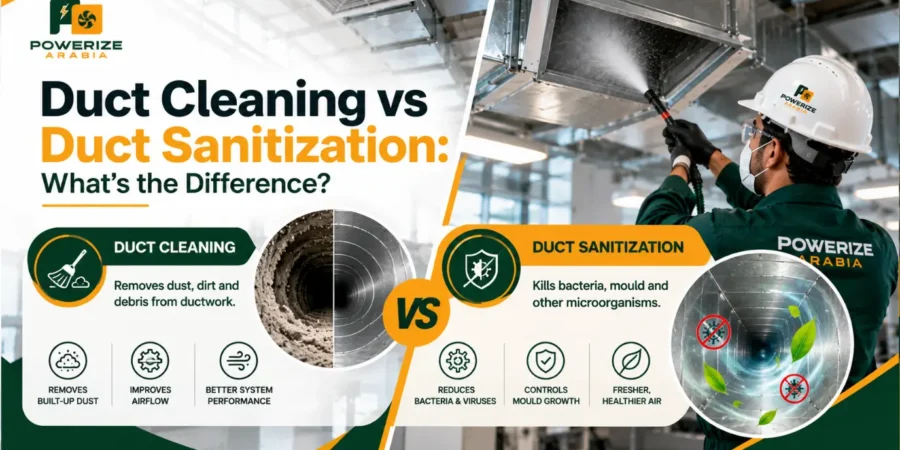
People use the terms almost interchangeably, but duct cleaning and duct sanitization are two different services that solve two different problems. Duct cleaning removes the physical dust and debris sitting inside your ductwork. Duct sanitization treats the surfaces with a product designed to kill germs, bacteria, and mould. One deals with what you can see; the other deals with what you cannot.
Knowing which one your building actually needs, and in what order, saves you from paying for the wrong service or skipping a step that matters. This guide breaks down what each does, how they differ, and when they belong together.
What Is Duct Cleaning?
Duct cleaning is the physical removal of dust, dirt, debris, and contaminants from the inside of a building’s HVAC ductwork and connected components. It targets the solid matter that collects over time: the dust, lint, pet dander, pollen, and general grime that builds up on duct walls, registers, coils, and fans.
The method is mechanical. Technicians use agitation tools such as brushes and air whips to dislodge the buildup, then capture it with a powerful HEPA-filtered vacuum working under negative pressure, so the debris is drawn out of the system rather than scattered into the room. The goal is a visibly clean duct interior and restored airflow. In entity terms: the entity is duct cleaning, its target is physical debris, its method is mechanical agitation plus vacuum extraction, and its result is a clean, free-flowing system.
Because so much of this work happens out of sight, the difference between a thorough job and a superficial one is easy to miss. A proper cleaning addresses the entire airside surface of the system, not just the visible vents. If you want the full picture of what a professional service covers from start to finish, our complete guide to commercial duct cleaning walks through every stage.
What Is Duct Sanitization?
Duct sanitization is the application of an antimicrobial product to the interior surfaces of the ductwork to kill or inactivate microorganisms such as bacteria, mould, and mildew. Where cleaning removes bulk material, sanitization treats what remains at a microbial level: the living contaminants a vacuum cannot pull out.
The method is chemical rather than mechanical. A technician applies an antimicrobial agent, usually by fogging or spraying it through the system, so it coats the duct surfaces. The goal is not to remove dust but to disinfect, reduce odours, and address biological growth. In entity terms: the entity is duct sanitization, its target is microorganisms, its method is antimicrobial application, and its result is a disinfected surface with reduced microbial load and odour.
An important point: any product applied should be one registered for this use. In the United States, antimicrobial products are registered with the U.S. Environmental Protection Agency, and a responsible provider uses only approved products and tells you exactly what they are applying and why.
It also helps to be clear about what sanitization does not do. It does not remove dust, it does not improve airflow, and it is not a permanent fix. If the underlying conditions that allowed microbial growth remain, such as a leak or persistent humidity, the growth can return, which is why sanitization works best as part of a wider response rather than a standalone spray. Guidance from public-health bodies such as the U.S. Centers for Disease Control and Prevention is consistent on this point for mould in particular: the lasting solution is controlling the moisture that feeds it, not simply treating the surface.
The Core Difference, Side by Side
The cleanest way to see the distinction is to line up the same attributes for each service. The table below does exactly that.
| Attribute | Duct Cleaning | Duct Sanitization |
|---|---|---|
| Target | Dust, debris, physical buildup | Bacteria, mould, microorganisms |
| Method | Mechanical agitation and HEPA vacuum | Antimicrobial product applied by fog or spray |
| Purpose | Restore airflow and remove contaminants | Disinfect surfaces and reduce odours |
| Deals with | What you can see | What you cannot see |
| Result | Visibly clean ductwork | Reduced microbial load |
| Always needed? | Yes, as the baseline service | Only when biological growth or odour is present |
The single most useful line in that table is the last one. Cleaning is the baseline that most systems need on a schedule. Sanitization is a targeted add-on for a specific problem, not a routine step for every building.
Do You Need Both?
In most cases, cleaning comes first and sanitization follows only if it is warranted. The reason is simple: an antimicrobial product cannot do its job properly if it is sprayed onto a thick layer of dust. The dust shields the surface and gives the treatment nothing solid to act on. So the correct sequence, when both are needed, is always clean first, then sanitize.
Whether you need the second step depends on what is actually in your system:
- Cleaning alone is usually enough when the issue is ordinary dust buildup, reduced airflow, or general upkeep. Most routine maintenance falls here.
- Cleaning plus sanitization makes sense when there is visible mould, a persistent musty or biological odour, recent water damage or high humidity, or an occupant health concern that points to microbial growth.
Be cautious of any provider that pushes sanitization as a mandatory part of every job, or uses it to mask ducts that were never properly cleaned. Sanitization is a treatment for a diagnosed problem, not a substitute for doing the cleaning right.
Why Cleaning Is the Foundation
It is worth stressing why cleaning, not sanitizing, is the service nearly every building needs on a schedule. The dust and debris that collect inside ductwork do two things that sanitizing cannot fix. First, they degrade the air occupants breathe, because every time the system runs it recirculates those particles into the rooms. The connection between dirty ductwork and the air people inhale is direct, and we cover it in full in our guide on duct cleaning and indoor air quality.
Second, that same buildup coats coils and blower components and chokes airflow, which forces the HVAC system to work harder and draw more power to deliver the same cooling. Sanitizing does neither of these things. It kills microbes, but it does not remove the dust load that drives poor air quality and high bills. That is the core reason cleaning is the baseline and sanitization is the exception.
Which One Does Your Building Need?
For a commercial or industrial building, the decision usually comes down to the environment and what an inspection reveals. A dusty warehouse or office in a hot, arid region primarily needs regular cleaning to keep airflow and air quality up. A building that has suffered a leak, sits in high humidity, or shows signs of mould growth is a candidate for sanitization on top of cleaning.
The right answer also varies by the kind of facility you run. A food-processing plant, a hospital, and a general office each face different contamination profiles and different regulatory expectations, which is why cleaning frequency and approach are best matched to your sector rather than a generic schedule.
The safest approach is to let a professional inspect the system first. A proper assessment shows whether you are dealing with a dust problem, a microbial problem, or both, so you pay for what the building genuinely needs rather than a one-size-fits-all package.
Frequently Asked Questions
1. Is duct sanitizing the same as duct cleaning?
No. Duct cleaning mechanically removes dust and debris from the system. Duct sanitizing applies an antimicrobial product to kill bacteria, mould, and other microorganisms. They solve different problems and use different methods.
2. Should I clean or sanitize first?
Clean first, always. Sanitizing over a layer of dust is ineffective because the antimicrobial product cannot properly reach and treat the surface. Cleaning exposes the surface so any sanitizing step can work.
3. Does every duct system need sanitizing?
No. Most systems need routine cleaning, but sanitizing is only warranted when there is actual biological growth, a musty odour, recent water damage, or a specific health concern. It is a targeted treatment, not a routine step.
4. Are the chemicals used for sanitizing safe?
When a provider uses products registered for this purpose and applies them correctly, sanitizing is considered safe. Ask exactly what product is being used, and avoid any provider who will not tell you.
5. Can duct cleaning remove mould?
Cleaning removes loose material and surface debris, but established mould growth often needs a combination of cleaning and a targeted antimicrobial treatment, and in serious cases, removal of affected components. An inspection determines the right response.
6. What is the difference between air duct cleaning and duct sanitizing?
Air duct cleaning mechanically removes dust and debris from the ductwork, while duct sanitizing applies an antimicrobial product to kill bacteria and mould. Cleaning handles what you can see; sanitizing handles what you cannot.
7. Do I need to sanitize my air ducts after cleaning them?
Only if there is mould, a musty odour, water damage, or biological growth. For ordinary dust buildup, cleaning alone is enough and sanitizing is not needed.
8. Should air ducts be cleaned or sanitized first?
Air ducts should always be cleaned first, because sanitizing products cannot work properly on surfaces still covered in dust. Clean first, then sanitize if required.
9. Does air duct cleaning kill mould and bacteria?
No, standard air duct cleaning removes dust and debris but does not kill mould or bacteria. Killing microorganisms requires a separate antimicrobial sanitizing treatment.
10. Is duct sanitizing worth it for a commercial building?
Duct sanitizing is worth it for a commercial building only when an inspection finds mould, odours, or microbial growth. Routine commercial systems usually need regular cleaning rather than sanitizing.
11. How often should commercial air ducts be cleaned and sanitized?
Commercial air ducts are typically cleaned every few years, more often in dusty or humid buildings, while sanitizing is done only as needed when biological growth is present.
Clean First, Then Treat Only If You Need To
The difference comes down to this: duct cleaning removes the dust, and duct sanitization kills the germs. Cleaning is the baseline nearly every system needs on a schedule. Sanitization is a targeted treatment for mould, odours, or biological growth, applied after cleaning and only when the situation calls for it. Understanding the split means you invest in what your building actually needs.
If you manage a facility in the Eastern Province and want an honest assessment of which your system requires, Powerizearabia provides a professional Duct Cleaning service in Al Jubail and the wider region, with inspection-led recommendations, proper HEPA-filtered equipment, and clear advice on whether sanitization is genuinely needed. Contact Powerizearabia to book an inspection for your building.