

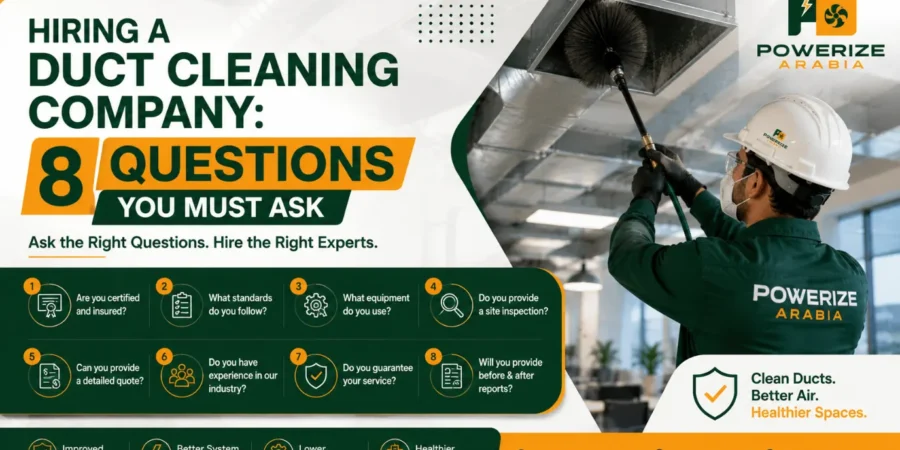
In the Eastern Province, ductwork takes a beating. Fine desert dust, coastal humidity off the Gulf, and near-year-round air conditioning mean the ducts in homes and facilities across Al Jubail, Dammam, and Khobar fill with debris faster than in most climates. So the decision to clean them is easy. Choosing who does it is where people get burned.
Duct cleaning is one of those services where the work happens out of sight, inside walls and ceilings, and by the time you realize a job was done poorly, the technician has already been paid and left. The fix is simple: ask the right questions before anyone touches your system. The eight below take about ten minutes to work through and will separate a seasoned professional from a cut-rate operator every time.
1. Are You Licensed and Fully Insured — Can I See Proof?
This is non-negotiable. Any contractor working inside your property should carry proper liability insurance, and a verbal “yes, we’re insured” is not proof. Ask them to send documentation directly before booking.
| What to Request | Why It Protects You |
| Certificate of general liability insurance | Covers property damage to ducts, flooring, or HVAC components during the job |
| Worker/labour injury coverage | Protects you if a technician is injured on your premises |
| Valid trade licence | Confirms the company is a registered, accountable business |
A logo on a website or business card is not a certificate. A company that hesitates to send real documentation has already answered a different question for you.
2. How Long Have You Been in Business — Can You Show References?
Longevity is a meaningful signal in an industry where fly-by-night operators cycle through names and service areas to escape bad reviews. This isn’t about dismissing newer companies; it’s about a verifiable track record.
A company operating for several years under the same name should have online reviews you can check. Give more weight to reviews with real detail — technician’s name, date, what was actually done — than to bare star ratings. When calling a reference, ask three sharp questions: Did the technician explain the work at each stage? Were there charges beyond the written estimate? Would you book them again, and what would make you hesitate?
3. Do You Follow Recognised Duct Cleaning Standards?
Reputable operators work to established industry standards rather than improvising. Internationally, bodies like NADCA (the National Air Duct Cleaners Association) and the US EPA publish duct cleaning guidelines and post-cleaning checklists that serious companies benchmark against.
| Answer You Hear | What It Really Means |
| Cites a specific standard and can explain their process | Good sign — they work to a documented method |
| “We follow the standards” with nothing concrete | Weak — following in name only is not the same as applying them |
| A logo with no verifiable credential behind it | Red flag — a badge is not a certification |
Ask which standard they work to and whether they’ll follow a post-cleaning checklist you can review.
4. What Equipment Do You Use — Is Your Vacuum Truck-Mounted?
This single question is the fastest way to tell whether a company can actually do the job. Effective duct cleaning has two parts: agitation (knocking debris loose) and containment (pulling it out).
| Component | What a Professional Uses | Red Flag |
| Containment vacuum | Truck-mounted or industrial unit creating true negative pressure across the whole system | Small handheld vacuum sold as adequate for a whole property |
| Agitation tools | Air whips, compressed-air wands, rotary brushes to dislodge stuck-on residue | Vacuuming only, with no wall-agitation step |
| Debris pathway | Debris pulled to a sealed collection tank outside | Debris allowed to redistribute into living spaces |
One honest caveat professionals will admit: raw suction doesn’t always scale with size — a strong portable unit placed right at the furnace can out-pull a truck-mounted system parked far away. What matters is that the equipment generates genuine negative pressure across your entire system, not just near one vent.
5. Do You Perform a Camera Inspection Before and After?
Before-and-after documentation is the most objective proof a customer can get. A camera inspection at the start shows the real condition of your ducts and highlights the areas needing extra attention. Photos at the end prove the work was completed.
Treat this as a standard deliverable, not a premium add-on. If a company won’t show you before-and-after images, be cautious. Before the technician leaves, review the photos together, confirm every register is reattached and secured, walk to several vents to check airflow, and get the written record of work before final payment.
6. What Exactly Does Your Cleaning Cover?
“Whole-house” or “whole-building” means nothing until it’s itemised. A complete cleaning covers far more than the main trunk lines. Ask the company to list precisely what’s included in the quoted price — a professional answers without hesitating.
A thorough scope should include:
- Supply ducts throughout the property
- Return ducts throughout the property
- All supply and return registers and grilles (removed, cleaned, reattached)
- Main trunk lines
- Air handler or furnace compartment, where accessible
- Drip pans, where accessible
Because HVAC components work as one connected system, a good technician will also check related parts — the coil, air handler, and similar — that can re-contaminate freshly cleaned ducts, and offer fair pricing if those need attention too. If registers and vents aren’t in the scope, you’re not getting a full cleaning no matter what the invoice says.
7. How Is Pricing Structured — Will I Get a Written Estimate?
Bait-and-switch pricing is the most common complaint in this industry, and it follows a pattern: a low headline price, then charges that appear once the technician is already inside. Get ahead of it.
| Legitimate Approach | Warning Sign |
| Per-job price based on system size assessed before quoting | Suspiciously cheap per-vent teaser rate |
| All components and possible add-ons listed in writing upfront | Vague “whole-house” scope with no itemisation |
| Extra costs disclosed before work begins | Add-ons revealed only after work starts |
Also ask what it costs to clean additional HVAC systems if your property has more than one unit, and what could raise the price — extra square footage, construction dust in the ducts, or an animal nesting inside (it happens). A trustworthy company discloses these upfront and lets you accept or decline recommendations without pressure.
8. How Do You Protect My Property — and Do You Use Chemicals?
Duct cleaning is inherently messy, so a reputable company arrives with a protocol for keeping your space clean — without being asked. Technicians should lay floor coverings along the work path, use shoe covers, seal the vacuum connection so negative pressure pulls debris outward, and use magnetic covers over return vents to prevent blowback into your rooms.
On chemicals: some companies apply disinfectants or biocides after cleaning. If you’d rather not have chemical residue circulating through your HVAC system, ask directly whether they use them and exactly what products. A responsible provider explains what they apply and why, and never sprays anything without telling you first.
A Quick Reference Before You Book
| Question | You Want to Hear |
| Licensed and insured? | Yes, with documents sent directly |
| Years in business / references? | Verifiable track record and detailed reviews |
| Recognised standards? | A named method and post-cleaning checklist |
| Vacuum type? | Truck-mounted/industrial with agitation tools |
| Before-and-after camera? | Standard on every job |
| Cleaning scope? | Every duct, register, trunk line, and accessible component |
| Pricing? | Written, per-job, no surprise add-ons |
| Home protection and chemicals? | Clear protocol; full disclosure on any products |
Frequently Asked Questions
1. How often should ducts be cleaned in the Eastern Province?
There’s no universal interval, but the region’s dust and humidity build debris faster than in mild climates. Cleaning is clearly warranted with visible mould inside the ducts, pest activity, or ducts visibly clogged and shedding particles into the air. Age of the property, recent renovation, and occupants with allergies also justify a service.
2. How long does professional duct cleaning take?
A thorough cleaning of a standard home typically runs a few hours depending on system size and buildup. Larger or multi-system properties take longer.
3. Is a very cheap quote a bad sign?
Often, yes. A headline price far below the market usually signals portable-only equipment, an incomplete scope, or add-on charges introduced once the technician is already working inside.
4. Should I get before-and-after photos even if my ducts are cleaned regularly?
Yes, for the record — though if your ducts are maintained often, the difference between the images may be subtle, which is itself a good sign.
Book a Duct Cleaning Company You Can Verify — PowerizeArabia Limited Company
If you’re hiring a duct cleaning company in Al Jubail, Dammam, or Khobar, you deserve a provider that answers every one of these eight questions without hesitation. PowerizeArabia Limited Company delivers professional, standards-based duct and HVAC cleaning across the Eastern Province — proper insurance and documentation, truck-mounted extraction with agitation tools, before-and-after camera inspection, a fully itemised scope, transparent written pricing, and a home-protection protocol on every job.
Ask us all eight. We’ll answer straight — and prove it on site.
Get in touch with PowerizeArabia Limited Company for a clear, written duct cleaning estimate for your home or facility in Al Jubail, Dammam, or Khobar.